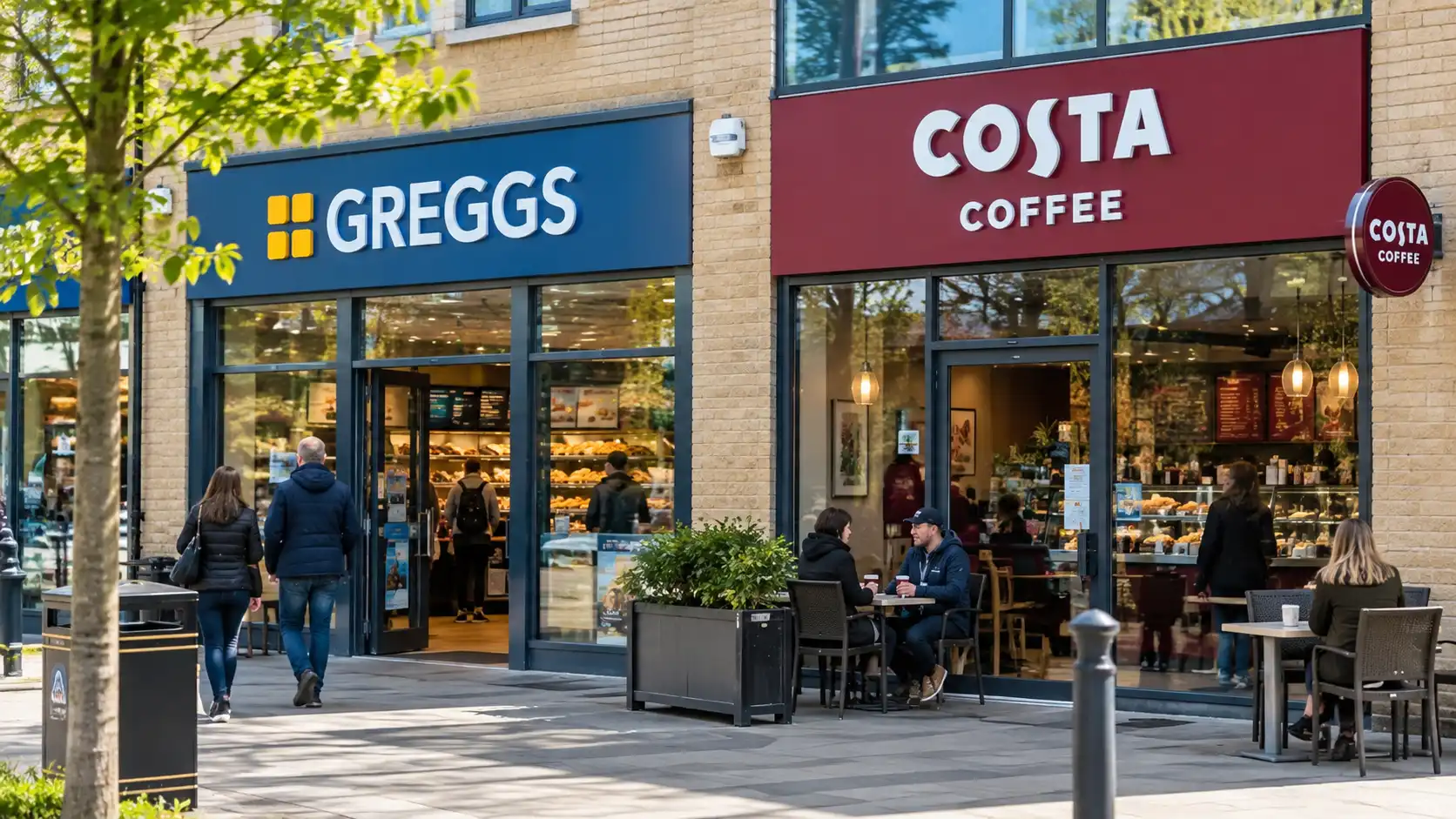
Greggs has overtaken Costa Coffee to become the UK’s largest overall branded coffee shop operator by outlet count, marking a major change in a market Costa had dominated for years.
Data from Allegra World Coffee Portal’s Project Café UK 2026 placed Greggs at 2,737 outlets, narrowly ahead of Costa Coffee at 2,707. That gave Greggs a lead of 30 locations in the market snapshot and made it the first new overall market leader since Costa overtook Starbucks in 2007.
However, there is an important detail missing from much of the recent coverage.
The 2,737 figure is not Greggs’ latest company-reported shop total. Greggs subsequently reported that it had 2,773 shops trading as of 27 June 2026, after opening 34 net new shops during the first half of the year. The Project Café figure and Greggs’ June figure therefore represent different reporting points rather than conflicting measurements of exactly the same date.
That distinction matters because the story is bigger than one bakery chain adding more shops than a coffee chain. It shows how the boundaries between bakeries, cafés, convenience outlets and food-to-go businesses are becoming increasingly blurred.
Greggs vs Costa UK in 2026: The Key Numbers
| Measure | Greggs | Costa Coffee |
| Project Café UK 2026 outlet count | 2,737 | 2,707 |
| Position by overall branded outlets | 1st | 2nd |
| Latest Greggs company-reported estate | 2,773 at 27 June 2026 | — |
| Main positioning | Food-to-go, bakery and coffee | Coffee-focused café chain |
| Long-term UK Greggs target | At least 3,500 shops | — |
| Project Café market share | Around 22% | Around 22% |
| Consumer positioning | Strong emphasis on value and convenience | Coffee experience, stores and beverage range |
The wider UK branded coffee shop market reached 12,313 outlets and was valued at approximately £6.8 billion, with outlet numbers growing 3.5% and market sales rising 5.5% over the period measured by Project Café UK 2026.
Has Greggs Really Overtaken Costa?
Yes. if “biggest” means the number of outlets counted across the overall UK branded coffee shop market.
That qualification is important.
Greggs is primarily a food-to-go bakery business that also sells significant volumes of coffee and other drinks. Costa is a dedicated coffee-focused operator.
World Coffee Portal therefore describes Greggs as the UK’s largest overall branded coffee shop operator, while Costa remains the country’s largest coffee-focused operator.
This also means headlines suggesting Greggs has automatically become Britain’s “most popular coffee shop” go further than the outlet data proves.
In fact, Costa was named the Nation’s Favourite Coffee Shop for the 16th consecutive year in World Coffee Portal research published in February 2026. The recognition was based on a survey of more than 5,000 UK coffee consumers.
So two things can simultaneously be true:
Greggs has more overall branded outlets, while Costa can still rank as consumers’ favourite dedicated coffee shop brand.
That is one of the most important distinctions for interpreting the “Greggs overtakes Costa UK” story correctly.
Did Greggs Only Overtake Costa in September 2026?
Not exactly.
The story gained significant fresh attention in September 2026, but Project Café UK 2026 was originally published earlier in the year. World Coffee Portal was already describing Greggs as the new overall market leader by February 2026.
The September coverage has therefore reignited an existing market development rather than identifying a change that occurred for the first time on 18 September.
This timing distinction is particularly useful because several recent reports combine the Project Café outlet figures with Greggs’ later first-half expansion.
Greggs’ own interim update gives the clearer chronology. By 27 June 2026, the company said its estate had reached 2,773 shops, following 34 net openings during the first half.
As of 19 September 2026, that 2,773 figure is the most recent clearly stated total in Greggs’ published financial update. Its next trading update will provide another opportunity for the company to disclose how far the estate has expanded since June.
Why Is Greggs Beating Costa on Outlet Numbers?
Price is clearly part of the explanation, but it is not the whole story.
Greggs has created a business model built around value, speed, frequent transactions and convenient locations.
Coffee does not need to operate as a standalone destination inside Greggs. It can be attached to breakfast, lunch, a sausage roll, sweet treat or snack.
That gives the company an advantage that conventional café operators do not always have.
A customer might enter Greggs primarily for breakfast but add a coffee. Another might buy a coffee because the Greggs location happens to sit inside a railway station, shopping centre or petrol forecourt.
The company describes value and convenience as central parts of its strategy, supported by digital platforms, digital ordering and a continued push to make Greggs available in more locations.
Hospitality analyst Peter Backman captured the wider market change particularly succinctly in his September briefing for the Beverage Standards Association:
“The UK coffee market is splitting in two.”
Backman’s analysis points towards a polarisation between strong-value operators such as Greggs and a growing collection of premium coffee businesses, leaving traditional middle-market chains facing pressure from both directions.
How Big Is the Price Difference Between Greggs and Costa?
Recent price comparisons help explain why Greggs appeals to cost-conscious customers.
LBC’s September 2026 comparison of medium black Americanos listed a Greggs Americano at £1.80, compared with £4.20 at Costa. Prices can vary between locations and formats, so those figures should be treated as a contemporary comparison rather than a guaranteed nationwide price in every shop.
Even so, the gap illustrates Greggs’ wider competitive position.
Customers are not necessarily deciding whether Greggs produces a “better” coffee than Costa. Many are deciding whether they need a traditional café experience at all.
For a commuter wanting coffee before boarding a train, an office worker buying breakfast or somebody looking for an inexpensive hot drink, speed and price can matter as much as seating, atmosphere or a wider espresso menu.
That makes the Greggs-Costa battle partly a business-model competition, not simply a coffee-quality competition.
Greggs’ Financial Performance Supports the Expansion
The outlet story is supported by Greggs’ recent trading performance.
For the 26 weeks ending 27 June 2026, Greggs reported total sales of approximately £1.1 billion, an increase of 7.2%.
Like-for-like sales in company-managed stores rose 2.1%, while the company’s operating profit increased 22.9% to £86.5 million and profit before tax increased 19.7% to approximately £76 million.
Chief executive Roisin Currie said:
“Greggs continued to outperform the market and has delivered an improved sales performance and strong cost control.”
Greggs has also indicated that it expects approximately 100 to 110 net new shop openings during 2026 and sees capacity for at least 3,500 UK shops over the longer term.
This is important because Greggs has not reached the top of the outlet table and then stopped expanding.
Its strategy remains explicitly growth-orientated.
Greggs Is Finding Places Where Normal Shops Do Not Fit
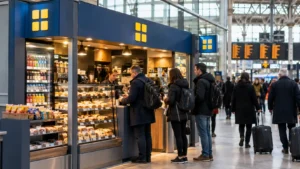
One of the more significant developments missing from many reports about Greggs overtaking Costa is how the company is changing what counts as a Greggs location.
The company is experimenting with smaller and more flexible formats that allow it to enter spaces where a conventional Greggs shop would be difficult.
Its Greggs Express concept is a compact self-service format offering products including savouries, sweet items and Fairtrade hot drinks. The first unit opened through Motor Fuel Group near Glasgow Airport in May 2026, with further travel-hub testing planned.
Greggs is simultaneously expanding its Bitesize Greggs format.
In September 2026, it opened its first supermarket Bitesize Greggs inside the Tesco Southwark Superstore. The format had already appeared at locations including London Bridge Station, Sevenoaks Railway Station, Dartford Station and Cheshire Oaks Designer Outlet.
Property director Tony Rowson described Bitesize as an important part of the company’s growth strategy because it allows Greggs to reach customers in locations where space is limited.
That could become particularly significant for coffee competition.
Greggs no longer needs every new site to accommodate the footprint of a conventional bakery. Compact units, supermarkets, forecourts and transport hubs can extend its coffee distribution network without relying entirely on traditional high-street property.
Costa Is Not Simply Shrinking Away
Greggs overtaking Costa should not be interpreted as evidence that Costa has disappeared from the growth conversation.
Costa added 36 net UK stores during 2025, including 21 drive-through locations, according to World Coffee Portal. It also invested heavily in refurbishing its existing estate.
More recent reporting suggests that turnaround work is beginning to produce results.
Costa chief executive Philippe Schaillee has been overseeing a programme that has refreshed more than 1,000 UK and Ireland locations while putting greater emphasis on store design, cold beverages and younger consumers.
Discussing the problem Costa faced before the programme, Schaillee said:
“If you came into a store three years ago, customers under 35 weren’t there.”
Recent reporting based on his comments indicates Costa generated around £1.74 billion of revenue in 2025, up 3.5%, and that pre-tax profit improved substantially. Costa also reportedly delivered its strongest first-half like-for-like transaction growth in more than a decade during 2026.
There is an accounting caveat.
As of 19 September 2026, Costa Limited’s statutory accounts for the year ending 31 December 2025 had not yet appeared on Companies House. Companies House lists those accounts as due by 30 September 2026, so the newer 2025 performance figures should currently be understood as recently reported company information rather than figures independently taken from the filed statutory accounts.
That makes Costa’s next filing particularly worth watching.
The Real Story Is the Changing Definition of a Coffee Shop
The more significant business lesson is not simply that Greggs has 30 more outlets in one industry dataset.
Britain’s coffee market is changing structurally.
A dedicated café is no longer the only place competing for the morning coffee transaction.
Coffee can now be bought from bakeries, fast-food restaurants, convenience stores, petrol stations, supermarkets, railway stations, drive-throughs and increasingly sophisticated self-service machines.
At the same time, premium operators are targeting consumers willing to pay more for specialty coffee, unusual beverages, design-led stores and stronger hospitality experiences.
World Coffee Portal describes the market as becoming increasingly polarised between affordable operators and premium businesses, alongside the growth of trends such as iced drinks and matcha.
Greggs fits the first side of that equation particularly well.
It does not have to convince every customer that it is Britain’s ultimate coffee destination. It needs to convince millions of customers that its coffee is good enough, convenient enough and attractively priced enough to add to an existing food purchase.
At national scale, that is a powerful proposition.
Is Greggs Now Bigger Than Costa Everywhere?
No.
The Project Café ranking concerns the overall UK branded coffee shop market by outlet count.
It does not mean Greggs has overtaken Costa on every possible measure, such as dedicated café locations, coffee revenue, consumer preference, international presence or number of specialist coffee products.
Costa also operates internationally and has a substantial Costa Express self-service network, which is conceptually different from counting conventional branded shop outlets.
Therefore, “Greggs overtakes Costa” is accurate when attached to the correct metric:
Greggs has overtaken Costa as the UK’s largest overall branded coffee shop operator by outlets in Project Café UK 2026.
It should not be expanded into claims that Greggs has surpassed Costa on every measure of coffee-market leadership.
What Happens Next in the Greggs vs Costa Battle?
Greggs appears determined to extend its physical reach.
Its traditional shop pipeline, Bitesize locations, Greggs Express trials and continued expansion into travel, retail and convenience environments provide several routes towards its ambition of at least 3,500 UK locations.
Costa’s response is different.
Rather than attempting to win solely by opening more conventional cafés, it is investing in its existing estate, customer experience, drive-through presence and beverage innovation.
That creates two contrasting strategies.
Greggs is attempting to make itself available in more places and for more everyday food-and-drink occasions.
Costa is attempting to make its established coffee-shop experience more attractive, particularly to customers whose expectations around store design and cold or premium beverages have changed.
Neither strategy guarantees future leadership.
But Greggs overtaking Costa on overall outlet numbers demonstrates how much competitive power has moved towards businesses that can combine food, coffee, price and convenience in one high-volume proposition.
Final Takeaway
Greggs overtaking Costa is a genuine landmark for the UK coffee and food-to-go industry, but the headline needs context.
Project Café UK 2026 counted 2,737 Greggs locations against 2,707 Costa locations, making Greggs the largest overall branded coffee shop operator in the country. Greggs’ own subsequent results show that its estate had already grown further to 2,773 shops by 27 June 2026.
Costa nevertheless remains the UK’s largest dedicated coffee-focused operator and was named the Nation’s Favourite Coffee Shop for a 16th consecutive year in 2026.
The development therefore says less about Britain suddenly abandoning Costa and more about how coffee consumption itself is changing.
Greggs has successfully turned coffee into part of a much broader value-and-convenience proposition. With smaller stores, self-service concepts, supermarket locations and a long-term target of at least 3,500 UK shops, that strategy still has substantial room to expand.
For Britain’s coffee industry, the most important question may no longer be which coffee shop consumers prefer.
It may be whether consumers need a traditional coffee shop at all.