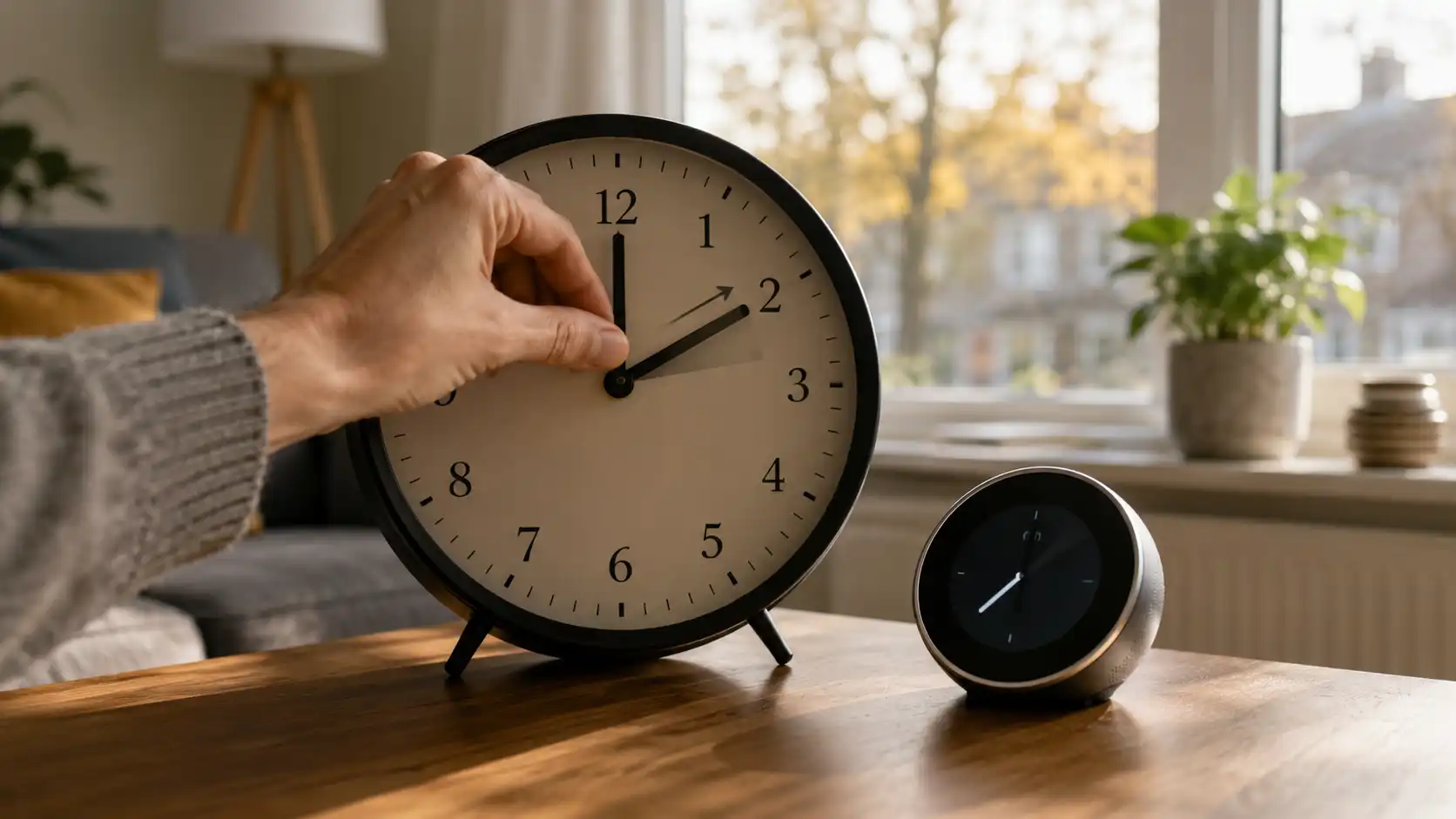
If you are wondering when do the clocks change in the UK, the answer is twice each year: once in spring and once in autumn.
In 2026, the clocks went forward on Sunday 29 March and will go back on Sunday 25 October 2026.
The next UK clock change is therefore Sunday 25 October 2026. At 2:00am British Summer Time (BST), the clocks will move back one hour to 1:00am Greenwich Mean Time (GMT). That means most people effectively gain an extra hour during the night.
The basic rule is easy to remember: the UK puts the clocks forward on the last Sunday in March and back on the last Sunday in October every year.
When Do the Clocks Change in 2026?
There are two UK clock changes during 2026.
| Clock Change | Date | What Happens? | Time |
| Clocks Go Forward | Sunday 29 March 2026 | 1:00am becomes 2:00am | Lose one hour |
| Clocks Go Back | Sunday 25 October 2026 | 2:00am becomes 1:00am | Gain one hour |
The March change has already taken place. This means the next clock change in the UK is on 25 October 2026, when British Summer Time ends and the country returns to Greenwich Mean Time.
If you regularly forget which way the clocks move, the familiar phrase “spring forward, fall back” is still the easiest way to remember it.
In spring, the clocks move forward.
In autumn, they move back.
When Do the Clocks Go Back in 2026?
The clocks go back on Sunday 25 October 2026.
At 2:00am BST, the time changes back to 1:00am GMT.
For most people, this means an extra hour in bed. It also means daylight arrives earlier in the morning while evenings begin getting dark earlier according to the clock.
The October clock change marks the official end of British Summer Time.
You may therefore notice the biggest practical difference in the days immediately afterwards when leaving work, travelling home or spending time outdoors during the late afternoon.
Businesses may also need to consider the change when organising overnight staff, automated systems or international meetings. Employers following developments around workplace organisation can find more coverage in iBusiness Magazine’s leadership and management section.
When Did the Clocks Go Forward in 2026?
The clocks went forward on Sunday 29 March 2026.
At 1:00am GMT, the clock jumped directly to 2:00am BST.
This meant one hour effectively disappeared during the night.
The change marked the beginning of British Summer Time, when UK clocks remain one hour ahead of Greenwich Mean Time.
Although losing an hour is not always welcome on a Sunday morning, moving the clocks forward means sunset occurs later according to the clock, creating longer, lighter evenings throughout spring and summer.
When Will the Clocks Change in 2027 and 2028?
UK clock changes follow a predictable pattern because they take place on the final Sunday of March and October.
The upcoming dates are:
| Year | Clocks Go Forward | Clocks Go Back |
| 2026 | 29 March | 25 October |
| 2027 | 28 March | 31 October |
| 2028 | 26 March | 29 October |
This makes it possible to plan well ahead, particularly for businesses running overnight operations, transport services, hospitality venues or systems that depend on accurate timestamps.
Why Do the Clocks Change in the UK?
The main idea behind changing the clocks is to make better use of daylight during the summer months.
During summer, daylight arrives very early in the morning. Moving the clock forward by an hour shifts part of that usable daylight into the evening instead.
The modern British system has its roots in the early twentieth century.
British builder William Willett became one of the best-known campaigners for changing the clocks after publishing The Waste of Daylight in 1907. His idea was based on making better use of daylight rather than wasting bright summer mornings while many people were still asleep.
The UK eventually introduced summer time in 1916.
The system has changed at various points during its history, but seasonal clock changes remain part of modern British life.
Today, British Summer Time begins in March and ends in October.
What Is British Summer Time?
British Summer Time, or BST, is the period when UK clocks are one hour ahead of Greenwich Mean Time.
BST begins when the clocks move forward in March.
For example:
12:00 noon GMT becomes 1:00pm BST.
British Summer Time provides more daylight according to the clock during the evening, although it does not actually create any additional daylight.
It simply changes how daylight hours line up with the times people commonly work, travel and spend their leisure time.
BST continues until the final Sunday in October.
What Is Greenwich Mean Time?
Greenwich Mean Time, commonly abbreviated to GMT, is the standard time used in the UK during the winter period.
When the clocks go back in October, Britain returns from BST to GMT.
The name comes from Greenwich in London, home of the historic Prime Meridian and the Royal Observatory.
Therefore:
- During winter, the UK operates on GMT
- During summer, the UK operates on BST, which is GMT+1
Understanding the distinction is particularly important for international businesses and remote teams scheduling calls with organisations in other countries.
Do the Clocks Change Everywhere in the UK?
Yes. England, Scotland, Wales and Northern Ireland all change their clocks at the same time.
There is not a separate clock-change system for Scotland or Northern Ireland.
When clocks go forward or back, the change applies across the UK simultaneously.
This keeps domestic travel, television schedules, business hours, transport and national services operating on the same time system.
Do Phones Change Time Automatically?
Most modern smartphones automatically change between GMT and BST, provided their automatic date and time settings are enabled.
The same is usually true for:
- Smartphones
- Tablets
- Laptops
- Desktop Computers
- Smartwatches
- Internet-connected Devices
However, not every clock in the house updates itself.
Traditional watches, alarm clocks, ovens, microwaves, central-heating timers and some car clocks may still need to be changed manually.
As businesses rely increasingly on connected software and automation, automatic time synchronisation has become standard across many digital systems. Readers interested in how technology is affecting everyday working life can also follow iBusiness Magazine’s technology and innovation updates.
There is also wider coverage of new technology trends and the way automation and connected platforms are changing modern workplaces.
Will My Alarm Still Work When the Clocks Change?
Normally, yes.
If an iPhone, Android phone or other smart device is configured to set the date and time automatically, the operating system should change the clock without you needing to do anything.
An alarm set for 7:00am should therefore still sound when the device displays 7:00am.
The issue is slightly different with older alarm clocks.
A traditional bedside clock will not know that British Summer Time has started or finished, so it normally needs to be changed manually before going to sleep.
It is worth checking the night before if being on time the following morning is important.
Do You Gain or Lose an Hour When the Clocks Change?
It depends on the time of year.
When the clocks go forward
You lose an hour.
At 1:00am in March, the clock jumps straight to 2:00am.
When the clocks go back
You gain an hour.
At 2:00am in October, the clock moves back to 1:00am.
That makes the autumn change considerably more popular with people hoping for an extra hour in bed.
Again, the simplest way to remember it is:
Spring forward – lose an hour.
Fall back – gain an hour.
Does the Clock Change Make the Days Longer or Shorter?
No. Changing the clocks does not alter how much daylight the UK actually receives.
The amount of daylight is determined by the Earth’s position and seasonal changes.
What changing the clocks does is shift the relationship between daylight and the time displayed on the clock.
When BST starts, sunrise and sunset appear approximately one hour later according to the clock.
When GMT returns in autumn, they appear approximately one hour earlier.
This is why evenings suddenly seem noticeably darker after the October clock change.
How Can the Clock Change Affect UK Businesses?
The clock change may seem like a small personal inconvenience, but some businesses need to plan around it carefully.
Companies operating standard Monday-to-Friday office hours are unlikely to experience much disruption because the change takes place during the early hours of Sunday morning.
It can be more significant for organisations operating overnight.
Examples include:
- Hotels
- Hospitals And Care Services
- Transport Operators
- Logistics Businesses
- Security Companies
- Manufacturing Sites
- 24-hour Customer Support Teams
- Hospitality Businesses
- Technology Platforms
An overnight shift may cross the exact point when the clock moves forward or backwards.
Companies should therefore make sure staff rotas, working-hour records and payroll systems interpret the change correctly.
Digital businesses should also check how software records timestamps. Most modern cloud services work with standardised time systems behind the scenes, but older or poorly configured systems may occasionally create confusing records around daylight-saving transitions.
Businesses relying on international partners face another consideration.
Not every country changes its clocks, and countries that do use daylight saving do not necessarily change them on the same dates.
For a few weeks each year, the normal time difference between Britain and another country can therefore change.
Businesses following operational developments and other issues affecting companies can keep up with the latest UK business news on iBusiness Magazine.
Why Are the Clocks Changed on a Sunday?
Changing the clocks during the early hours of Sunday helps reduce disruption.
Far fewer people are commuting, attending school or working traditional office hours at 1:00am or 2:00am on a Sunday than during a weekday.
However, that does not mean the change is disruption-free.
Night workers, transport operators, emergency services, hotels, airports and businesses operating around the clock still have to manage the missing or repeated hour.
For most households, though, Sunday morning remains one of the least disruptive times to make the change.
Is the UK Going to Stop Changing the Clocks?
There has been plenty of debate over whether the UK should continue changing its clocks twice a year.
Supporters of permanent summer time often argue that lighter evenings could benefit leisure activities, hospitality, tourism and some businesses.
Others point to darker winter mornings, particularly in northern parts of Britain, as an important reason to keep the existing arrangements.
As things currently stand, the UK is continuing with its existing clock-change system.
There is no confirmed change that would cancel the October 2026 clock change.
People should therefore still plan for the clocks to go back on 25 October 2026.
How Should You Prepare for the Clock Change?
Modern technology makes changing the clocks easier than it used to be, but it is still worth doing a quick check.
The evening before the change, look at any device that may not update automatically.
That could include an oven clock, boiler timer, wall clock, analogue watch, alarm clock or older vehicle dashboard.
Businesses should also consider whether Sunday appointments, staff shifts, automated jobs or international calls could be affected.
For the October change, putting manual clocks back before going to bed on Saturday night is usually the easiest approach.
For the March change, put them forward before sleeping.
What Is the Easiest Way to Remember Which Way the Clocks Change?
The most popular memory trick is:
“Spring forward, fall back.”
In spring, clocks jump forward by one hour.
In autumn — or “fall” in American English — clocks move back by one hour.
Another simple way to remember is to think about sleep:
March = one hour less.
October = one hour more.
Final Thoughts
For anyone asking when do the clocks change, the next date to remember is Sunday 25 October 2026.
At 2:00am, the clocks will go back one hour to 1:00am, ending British Summer Time and returning the UK to Greenwich Mean Time.
The system is straightforward once you remember the basic rule: clocks go forward on the final Sunday in March and back on the final Sunday in October. Most digital devices will make the change automatically, but manual clocks, household timers and some business systems are still worth checking.
Frequently Asked Questions
When Do the Clocks Change in 2026?
The UK clocks went forward on Sunday 29 March 2026 and will go back on Sunday 25 October 2026.
When is the Next Clock Change in the UK?
The next UK clock change is Sunday 25 October 2026, when the clocks go back one hour.
What Time Do the Clocks Go Back in October 2026?
At 2:00am BST on 25 October 2026, the clocks go back to 1:00am GMT.
Do the Clocks Go Forward or Back in October?
The clocks go back by one hour in October. This means you effectively gain an extra hour.
When Do the Clocks Go Forward Again?
After the October 2026 change, the clocks will next go forward on Sunday 28 March 2027.
Do Mobile Phones Automatically Change When the Clocks Change?
Most modern smartphones automatically update if automatic date and time settings are enabled. Traditional clocks and some household appliances still need to be changed manually.
Is the UK Stopping Daylight Saving Time?
There is currently no confirmed plan ending the UK’s seasonal clock changes. The existing system therefore continues, with clocks going forward in March and back in October.
Do Scotland and Northern Ireland Change Their Clocks?
Yes. England, Scotland, Wales and Northern Ireland all change their clocks at the same time.