
The LCWRA first payment after decision is not automatically paid a fixed number of days after the Department for Work and Pensions confirms an award.
For most claimants, the crucial dates are when the health condition was reported, when medical evidence started, the Universal Credit assessment-period dates and whether the normal three-month relevant period has already ended.
If LCWRA entitlement should have started before the decision was made, earlier assessment periods can be recalculated and arrears may be due. From 6 April 2026, the applicable LCWRA rate also matters because there are now separate higher and lower amounts.
Key Takeaways
- The LCWRA decision date does not normally start the waiting period.
- The normal relevant period is three months from the point medical evidence establishes limited capability for work, with LCWRA included from the appropriate later assessment period.
- For 2026/27, LCWRA is £217.26 a month at the lower rate or £429.80 at the higher rate.
- Someone moving from an existing LCW decision to LCWRA does not normally serve another three-month waiting period.
- LCWRA exempts a Universal Credit household from the Benefit Cap while the LCWRA element applies.
- LCWRA arrears do not count as income, although benefit-arrears capital rules should still be considered.
- Existing DWP overpayment debt can reduce a lump-sum arrears payment.
- Claimants who believe the effective date or payment amount is wrong can request a Mandatory Reconsideration.
- Special Rules for End of Life can remove the normal waiting period, with medical evidence usually provided through an SR1 form.
The official 2026 LCWRA rates and qualification rules can be checked in the GOV.UK guidance on LCWRA payments. GOV.UK confirms the 2026/27 amounts as £217.26 and £429.80.
What Happens After An LCWRA Decision?
When a Work Capability Assessment results in an LCWRA decision, the claimant is treated as having limited capability for work and work-related activity.
They normally no longer have to search for work or undertake work-preparation activity under their Universal Credit claimant commitment. GOV.UK also states that once someone has an LCW or LCWRA decision, they do not need to continue submitting fit notes for that decision.
The financial calculation is separate from the Work Capability Assessment decision itself.
The DWP may need to establish:
- when the health condition was reported;
- when sufficient medical evidence began;
- whether there were relevant gaps in that evidence;
- the claimant’s assessment-period dates;
- when the three-month relevant period ended;
- whether an exception to that period applies;
- which 2026 LCWRA rate applies;
- whether the Benefit Cap affected earlier periods;
- whether a work allowance changes earlier calculations; and
- whether previous Universal Credit assessment periods need to be recalculated.
This is why two claimants receiving an LCWRA decision on the same day can have completely different first-payment and backpay dates.
How Long After Being Awarded LCWRA Do You Get Paid?
There is no rule stating that LCWRA must be paid seven days, 14 days or one month after the decision.
GOV.UK says that where the normal rule applies, the extra LCWRA amount is usually payable after the required period following the start of medical evidence.
If that period has already finished by the time the Work Capability Assessment decision is made, the LCWRA element can be included in an upcoming Universal Credit award and the DWP may also owe money for earlier eligible assessment periods.
If it has not finished, the existence of an LCWRA decision does not automatically make the additional payment immediately payable.
There is an additional distinction for someone who is new to Universal Credit. A first ordinary Universal Credit payment normally arrives around five weeks after a claim is made. That five-week first-payment timetable is separate from the LCWRA relevant-period rules.
When Does The Three-Month LCWRA Period Start?
The LCWRA waiting period does not normally start when the decision letter arrives.
Regulation 28 of the Universal Credit Regulations provides for a three-month “relevant period”, generally beginning when the claimant first provides the required evidence that they have limited capability for work.
The LCWRA element is then included from the beginning of the assessment period following the assessment period in which the relevant period ends.
This is more precise than simply saying “wait three full Universal Credit months” or “count 90 days from the decision”.
For example, a claimant might begin providing medical evidence in January but not receive an LCWRA decision until August.
If the relevant period ended several months before August, LCWRA may already have become payable and eligible assessment periods between the effective date and implementation of the decision may need to be recalculated.
A recent Upper Tribunal decision published on 28 August 2026 also illustrates why Regulation 28 and the exact evidence dates matter when determining when LCWRA becomes payable.
How Do Assessment Periods Affect The First Payment?
Universal Credit is calculated through monthly assessment periods, so the first LCWRA payment cannot always be calculated accurately by adding exactly 90 days to a fit-note date.
Suppose a claimant’s assessment periods run from the 10th of each month to the 9th of the next month.
They first provide qualifying medical evidence on 15 January.
The three-month relevant period would run from that point into April. Because it ends during the assessment period running from 10 April to 9 May, the LCWRA element would normally begin from the next assessment period, starting 10 May.
If the claimant’s usual Universal Credit payment is seven days after the assessment period closes, that LCWRA-containing assessment period would ordinarily be paid in June.
Quick LCWRA Payment Example
| Stage | Example Date |
| Assessment periods | 10th to 9th |
| Medical evidence begins | 15 January |
| Three-month relevant period ends | Around 14 April |
| Assessment period containing the end of relevant period | 10 April to 9 May |
| First assessment period containing LCWRA | 10 May to 9 June |
| Approximate normal UC payment date | 16 June |
This table is an example rather than a universal “fit note month → payment month” calculator. A claimant with different assessment-period dates can receive LCWRA in a different month even if the first fit note was provided on the same date.
How Much Is The First LCWRA Payment?
The LCWRA system changed significantly from 6 April 2026, when a lower and higher LCWRA rate were introduced.
For the 2026/27 benefit year:
| LCWRA Category | Monthly Amount |
| Lower LCWRA amount | £217.26 |
| Higher LCWRA amount | £429.80 |
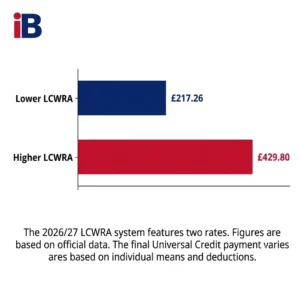
These figures are confirmed by GOV.UK and the official 2026/27 benefit-rate tables.
The LCWRA amount is one element within the wider Universal Credit calculation. A claimant may also have a standard allowance, housing costs, child elements, childcare costs or other elements.
The amount eventually reaching the claimant’s bank account can therefore differ from £217.26 or £429.80 because Universal Credit remains means-tested and can be affected by earnings, other income and authorised deductions.
Who Gets The Higher £429.80 LCWRA Rate In 2026?
The higher LCWRA amount can apply where the claimant:
- declared the relevant health condition before 6 April 2026;
- was already receiving LCWRA before 6 April 2026;
- falls within the protected pre-2026 rules;
- meets the severe and lifelong conditions criteria;
- qualifies under the Special Rules for End of Life; or
- falls within specified ESA-to-Universal-Credit protection rules.
A particularly important point is that someone who reported their health condition before 6 April 2026 can still qualify for the protected higher rate even where the LCWRA decision itself was made after 6 April.
For 2026/27, that higher amount is £429.80 per assessment period.
Who Gets The £217.26 LCWRA Rate?
The lower rate generally applies where someone:
- declared the health condition on or after 6 April 2026;
- does not qualify as a protected pre-2026 claimant;
- does not meet the severe and lifelong conditions criteria;
- is not covered by the Special Rules for End of Life; and
- is not entitled to the higher rate through the applicable couple rules.
The 2026/27 lower LCWRA amount is £217.26 per assessment period.
What Happens When Someone Moves From LCW To LCWRA?
A particularly important exception applies to someone who has already been determined to have Limited Capability for Work (LCW) and is later reassessed as having LCWRA.
They do not normally have to serve another three-month LCWRA relevant period.
Regulation 28 specifically disapplies the waiting-period rule where a claimant already has LCW and it is subsequently determined that they have LCWRA.
DWP decision-making guidance gives examples of the LCWRA element taking effect from the beginning of the relevant assessment period associated with the change or reassessment rather than imposing a fresh three-month period.
For example, where an existing LCW claimant reports that their condition has significantly worsened and is later found to have LCWRA, the effective date can potentially relate back to the assessment period connected with that reported change rather than three months after the eventual LCWRA decision.
The exact effective date depends on whether the reassessment followed a claimant-reported deterioration, a DWP-initiated review or another change, so it is important to check the decision rather than assuming the LCWRA decision date controls payment.
Is LCWRA Paid From The First Sick Note?
Usually, no.
The first medical evidence is important because it can establish when the relevant period begins, but it does not normally mean that the LCWRA element becomes payable immediately.
The usual sequence is:
Medical evidence begins → three-month relevant period → assessment period containing the end of that period → first assessment period containing LCWRA → payment
rather than:
First fit note → immediate LCWRA payment
There are exceptions, including existing LCW cases, certain ESA transfers and Special Rules for End of Life.
How Does LCWRA Backpay Work?
LCWRA backpay is usually relevant when the DWP reaches or implements the Work Capability Assessment decision after the date on which the LCWRA element should already have become payable.
The simplest starting calculation is:
Number of eligible earlier assessment periods × applicable monthly LCWRA rate
However, the final Universal Credit arrears calculation can be more complicated.
Adding LCWRA retrospectively can affect the work allowance, Benefit Cap and potentially other parts of the Universal Credit calculation.
For 2026/27, someone entitled to the work allowance can earn up to £427 a month before the Universal Credit taper applies where the award includes housing costs, or £710 where it does not.
That means the DWP may need to recalculate the entire relevant assessment period rather than simply multiply the LCWRA rate by the number of months owed.
What Could Three Months Of LCWRA Backpay Be Worth?
The following example assumes three complete assessment periods are owed and ignores other changes to the Universal Credit calculation.
| Eligible Backpay Period | Lower Rate | Higher Rate |
| Assessment period 1 | £217.26 | £429.80 |
| Assessment period 2 | £217.26 | £429.80 |
| Assessment period 3 | £217.26 | £429.80 |
| Illustrative total | £651.78 | £1,289.40 |
The actual amount could be higher or lower after DWP recalculates earnings, work allowances, the Benefit Cap, deductions and other Universal Credit elements.
Does Backdated LCWRA Count As Income?
Scope states that backdated LCWRA payments do not count as income, so receiving LCWRA arrears does not in itself reduce another means-tested payment as income in the month it arrives.
There is an additional capital rule worth knowing.
GOV.UK says benefits arrears payments are normally disregarded when Universal Credit assesses money, savings and investments for up to 12 months after receipt.
This distinction matters for someone receiving a large lump sum:
Backpay as income: not normally counted as current income.
Backpay retained as savings: benefit-arrears capital disregard rules can apply, normally for up to 12 months.
Someone receiving substantial arrears and already holding significant savings should therefore check the capital rules rather than assuming the lump sum can never affect a future Universal Credit calculation.
Does LCWRA Remove The Benefit Cap?
Yes. A household is not subject to the Benefit Cap for an assessment period where the LCWRA exemption applies.
GOV.UK specifically lists people getting Universal Credit because a health condition prevents them from working under LCWRA as not affected by the Benefit Cap.
This can be particularly important for LCWRA backpay.
Suppose a claimant was Benefit Capped for several assessment periods but the DWP later determines that LCWRA should have applied during those same periods.
Those periods may need to be recalculated without the Benefit Cap. The resulting arrears could therefore include more than the LCWRA element itself.
This is another reason a claimant should not estimate LCWRA backpay by simply multiplying £217.26 or £429.80 by the number of months owed.
Can DWP Take LCWRA Backpay For An Overpayment?
Potentially, yes.
Scope warns that someone expecting backdated Universal Credit may receive less than expected where DWP says an earlier benefit overpayment remains outstanding. DWP can use arrears to offset money that is owed.
For example, if a claimant calculates that £1,289.40 of higher-rate LCWRA arrears should be due but has an existing recoverable DWP debt, some or all of that lump sum could potentially be applied against the debt.
Claimants should check their Universal Credit journal and any correspondence from DWP Debt Management if the amount deposited is substantially lower than the arrears calculation shown on revised statements.
If the claimant disputes the underlying overpayment decision, that dispute is separate from the LCWRA calculation and can itself have review and appeal rights.
Can Someone Get LCWRA Backpay For The Three-Month Relevant Period?
Normally, no.
The three-month relevant period is ordinarily a period during which the LCWRA element is not yet included.
Backdating generally starts from the first assessment period in which the LCWRA element should legally have been included, rather than automatically going back to the first fit note.
That is why descriptions such as “LCWRA is always backdated to the first sick note” can be misleading.
Exceptions exist, including circumstances where Regulation 28’s waiting rule does not apply.
What Happens If There Is A Gap Between Fit Notes?
A gap in medical evidence can create a dispute about when the LCWRA relevant period started or whether the evidence was continuous enough for the dates being claimed.
A claimant should not simply assume that a gap permanently destroys their entitlement to an earlier effective date.
Where there is a genuine gap, they can ask their GP or another authorised healthcare professional whether medical evidence can appropriately cover the missing period.
A 2025 Upper Tribunal decision confirmed that, in the circumstances of that case, a later fit note covering an earlier period could help bridge an evidential gap when considered alongside the other evidence.
However, this is not an automatic guarantee that DWP will accept every backdated fit note.
The safer practical approach is to:
- ask the healthcare professional whether they can properly certify the earlier period;
- upload or report the evidence promptly;
- explain the gap through the Universal Credit journal; and
- ask DWP to confirm the medical-evidence date it is using for Regulation 28.
If the effective date is still disputed after a formal decision, the claimant may be able to request Mandatory Reconsideration.
Are There Exceptions To The Three-Month Period?
Yes.
The normal relevant period does not apply identically in every case.
Important exceptions include:
- a claimant moving from an existing LCW determination to LCWRA;
- certain claimants transferring from ESA;
- people covered by the Special Rules for End of Life; and
- specific continuity situations under Universal Credit legislation.
GOV.UK confirms that LCWRA can be added immediately in some circumstances, including certain ESA transfers and people who may have 12 months or less to live.
How Do The Special Rules For End Of Life And SR1 Form Work?
Where a medical professional says someone might have 12 months or less to live, they may qualify under the Special Rules for End of Life.
The claimant should ask an appropriate medical professional for an SR1 form. The medical professional can complete it and either give it to the claimant or send it to DWP.
A claimant covered by the terminal-illness rules is treated as having LCWRA and does not have to serve the normal three-month relevant period.
DWP decision-making guidance states that where an existing Universal Credit award is superseded under these rules, the LCWRA element can apply from the first day of the assessment period in which the relevant application is made, subject to the particular decision circumstances.
Someone covered by the Special Rules for End of Life also receives the higher LCWRA rate, which is £429.80 for 2026/27.
Does LCWRA Affect PIP Or Housing Support?
An LCWRA award does not itself cancel Personal Independence Payment.
PIP is a separate, non-means-tested benefit. Government material confirms that PIP entitlement is not based on income or savings.
A claimant can therefore potentially receive both PIP and the LCWRA element of Universal Credit if they separately meet the rules for each benefit.
Similarly, LCWRA does not automatically remove Universal Credit housing-cost support. Universal Credit can continue to include an amount towards eligible rent or housing costs where the claimant meets the relevant housing rules.
In fact, PIP itself can also provide a Benefit Cap exemption in appropriate cases.
Claimants in supported, sheltered or temporary accommodation may have different Housing Benefit arrangements, so “housing support” should not be assumed to mean exactly the same payment for every claimant.
Can Someone Get An Advance While Waiting For Payment?
There are two different situations to distinguish.
A New Universal Credit Claim
Someone making a new Universal Credit claim normally waits around five weeks for the first payment.
If money is needed sooner, GOV.UK says a claimant can apply for a first-payment advance. The advance can be up to 100% of the estimated first Universal Credit payment and is normally repaid over 24 months.
This is a Universal Credit first-payment advance, not a special LCWRA-backpay payment.
An Existing Claim Where Circumstances Have Changed?
GOV.UK also provides for an advance where a reported change of circumstances will make someone eligible for more Universal Credit.
Such an advance must normally be requested after reporting the change but before receiving the higher payment resulting from it, and repayment is normally made through later Universal Credit payments.
A claimant waiting specifically for an LCWRA recalculation should therefore ask Universal Credit which type of advance, if any, applies to their particular circumstances rather than assuming LCWRA arrears can automatically be paid early.
Why Is LCWRA Missing From The First Payment After The Decision?
Receiving an LCWRA decision does not guarantee that the immediately following Universal Credit statement will already contain the additional amount.
Possible reasons include:
- the relevant period has not yet ended;
- the decision was made after the next statement had already been calculated;
- DWP is still recalculating earlier assessment periods;
- DWP is using a different medical-evidence start date;
- there is a disputed gap in medical evidence;
- the claimant has calculated the assessment-period dates incorrectly;
- the claimant already had LCW and the effective-date rules have been applied differently;
- arrears have been referred against an existing overpayment debt; or
- another part of the Universal Credit calculation has changed at the same time.
The decision date by itself is therefore not enough to calculate the LCWRA first payment.
How Can A Claimant Check Their LCWRA Payment Date?
The claimant should collect:
- the date the health condition was first reported;
- the date qualifying medical evidence began;
- details of every fit note or other relevant evidence;
- the start and end dates of Universal Credit assessment periods;
- the LCW or LCWRA decision date;
- any previous LCW decision;
- any Benefit Cap deductions; and
- the rate DWP says applies.
They can then compare the date shown on the LCWRA decision with the dates shown on their Universal Credit statements.
It is particularly useful to check whether older statements have been revised because Universal Credit backdating can involve recalculating earlier assessment periods rather than simply sending an unexplained lump sum.
Does LCWRA Come As A Separate Payment?
The regular LCWRA element forms part of the claimant’s monthly Universal Credit award.
Backpay can be different.
Scope explains that LCWRA arrears can be paid separately from the claimant’s normal Universal Credit payment and can arrive at a different time.
A claimant could therefore receive:
- a regular Universal Credit payment that now includes LCWRA; and
- a separate lump sum for arrears.
A separate bank credit following an LCWRA decision does not automatically mean an error has occurred.
Does An LCWRA Decision Stop Fit Notes?
Yes, normally.
GOV.UK states that once someone has been assessed as having LCW or LCWRA, they no longer need to provide further fit notes for that Work Capability Assessment decision.
Before the decision is made, medical evidence should continue to be supplied where required.
This distinction matters because allowing evidence to expire before the WCA decision can create questions over the date from which the relevant period should be calculated.
When Will LCWRA Be Reassessed?
An LCWRA decision does not necessarily mean that the claimant will never have another Work Capability Assessment.
Official DWP statistics guidance says LCW and LCWRA cases can have a review period set by the healthcare professional or decision maker, commonly between six and 36 months, depending on the health condition. It also makes clear that not every case is automatically reassessed when that review period expires.
Scope describes typical LCWRA review points as around one, two or three years.
There are also cases where reassessment may not normally be required, particularly where a severe lifelong condition satisfies the relevant criteria.
The actual review timetable should therefore be treated as case-specific rather than a fixed LCWRA expiry date.
What Should Someone Do If Their LCWRA Payment Is Missing?
The claimant should first check their current and earlier Universal Credit statements.
They should then calculate the relevant period using the medical-evidence date and assessment periods and compare it with the effective date used by DWP.
A journal message can ask DWP to confirm:
- the medical-evidence start date being used;
- the date from which LCWRA has been applied;
- the first assessment period containing the LCWRA element;
- whether the lower or higher 2026 rate has been applied;
- whether the Benefit Cap has been removed from relevant earlier periods;
- whether earlier assessment periods are being recalculated;
- the gross arrears amount;
- whether any arrears have been offset against an overpayment; and
- when any remaining arrears will be paid.
Copy-And-Paste LCWRA Journal Message
Hello. I have received a decision that I have Limited Capability for Work and Work-Related Activity (LCWRA).
Please can you confirm the date from which my LCWRA entitlement has been applied, the medical-evidence date used to calculate the relevant period, and the first assessment period in which the LCWRA element is payable?
Please also confirm whether the £217.26 or £429.80 rate applies to my claim, whether any earlier assessment periods are being recalculated, whether the Benefit Cap needs to be removed from any of those periods, and the amount of any arrears due.
If any arrears have been reduced because of an existing overpayment or other deduction, please confirm the gross arrears amount and the amount deducted.
This gives DWP the specific questions needed to explain the calculation rather than simply asking when the money will arrive.
What Can Someone Do If DWP Has Used The Wrong LCWRA Date?
A journal message is a useful first step, but it is not the end of the process.
If DWP has issued a formal decision and the claimant believes the effective date, LCWRA status or another appealable part of the decision is wrong, they can normally ask for a Mandatory Reconsideration.
GOV.UK says a Mandatory Reconsideration normally needs to be requested within one month of the date on the decision letter. For Universal Credit, the request can be made through the claimant’s journal as well as by other permitted routes.
The claimant should explain exactly what they believe is wrong.
For example:
“I disagree with the date from which the LCWRA element has been included. I supplied evidence of limited capability for work on [date].
My assessment periods run from [date] to [date]. I believe Regulation 28 means the LCWRA element should have been included from the assessment period beginning [date]. Please reconsider the effective date.”
Evidence such as journal records, fit notes and previous decisions can be included.
If the Mandatory Reconsideration does not resolve the disagreement, tribunal appeal rights may follow depending on the decision.
What Is The Bottom Line On The LCWRA First Payment After Decision?
The LCWRA first payment after decision depends much more on assessment periods, medical-evidence dates and the claimant’s previous status than on the date printed on the Work Capability Assessment decision.
For a standard first LCWRA determination, Regulation 28 normally creates a three-month relevant period before the additional element is included. If the Work Capability Assessment takes longer than this, earlier eligible assessment periods can be recalculated and arrears may be due.
However, there are important exceptions.
Someone already assessed as LCW and later moved to LCWRA does not normally serve another three-month period. Special Rules for End of Life can also remove the waiting period, while certain ESA transfers have separate protection.
For 2026/27, the official LCWRA rates are £217.26 at the lower rate and £429.80 at the higher rate. The higher rate can apply to protected pre-2026 claimants, people satisfying the severe and lifelong criteria and people covered by the Special Rules for End of Life.
Backpay calculations should also take account of the work allowance, Benefit Cap exemption and any existing DWP overpayment debt.
A claimant who thinks the calculation is wrong should therefore check the medical-evidence date, assessment periods, LCW history, applicable rate and revised Universal Credit statements before estimating what is owed.
Frequently Asked Questions
How Long After Being Awarded LCWRA Do You Get Paid?
There is no fixed number of days after the decision. If the relevant period has already ended and LCWRA should already be included, it may appear in an upcoming Universal Credit payment and earlier eligible periods may be paid as arrears.
How Much Is The First LCWRA Payment In 2026?
For 2026/27, the LCWRA element is £217.26 per month at the lower rate or £429.80 at the higher rate. The claimant’s wider Universal Credit calculation determines how much actually reaches their bank account.
Does Someone Moving From LCW To LCWRA Wait Three Months Again?
Normally, no. Regulation 28 specifically provides that the normal relevant-period restriction does not apply where a claimant already has LCW and is subsequently determined to have LCWRA.
Does LCWRA Exempt Someone From The Benefit Cap?
Yes. LCWRA is one of the circumstances that exempts a Universal Credit household from the Benefit Cap. If LCWRA is applied retrospectively, earlier capped assessment periods may need to be recalculated.
Does LCWRA Backpay Count As Income?
Scope states that backdated LCWRA does not count as income. Benefits arrears are also normally disregarded as capital for Universal Credit purposes for up to 12 months after receipt.
Can DWP Take LCWRA Backpay For An Old Overpayment?
Potentially. DWP can use backdated benefit money against certain outstanding benefit debts, meaning the lump sum reaching the claimant may be lower than the gross LCWRA arrears calculated.
Can A Backdated Fit Note Fix A Gap?
Potentially, but it is not automatic. A healthcare professional may be able to provide evidence covering an earlier period, and case law shows that such evidence can sometimes bridge a gap. DWP must still decide whether the evidence establishes the earlier date.
Is LCWRA Paid From The First Sick Note?
Usually not. Medical evidence normally starts the relevant-period calculation rather than creating immediate entitlement to the LCWRA element.
Does LCWRA Affect PIP?
An LCWRA award does not itself stop PIP. PIP is a separate, non-means-tested benefit with its own eligibility rules.
Does LCWRA Stop Housing Support?
No. LCWRA does not automatically remove Universal Credit housing costs or other eligible housing support. The exact housing payment depends on the claimant’s accommodation and wider circumstances.
What Is An SR1 Form?
An SR1 is medical evidence used for benefit claims under the Special Rules for End of Life. A medical professional completes it where appropriate, and qualifying claimants can receive the higher LCWRA rate without the normal three-month relevant period.
When Is LCWRA Reassessed?
Review periods can vary. DWP guidance says review periods are commonly set between six and 36 months, although not every claimant is automatically reassessed when that period expires.
What If DWP Has Used The Wrong LCWRA Start Date?
The claimant should first request an explanation through the Universal Credit journal. If a formal decision remains disputed, they can normally request Mandatory Reconsideration, usually within one month of the decision date.