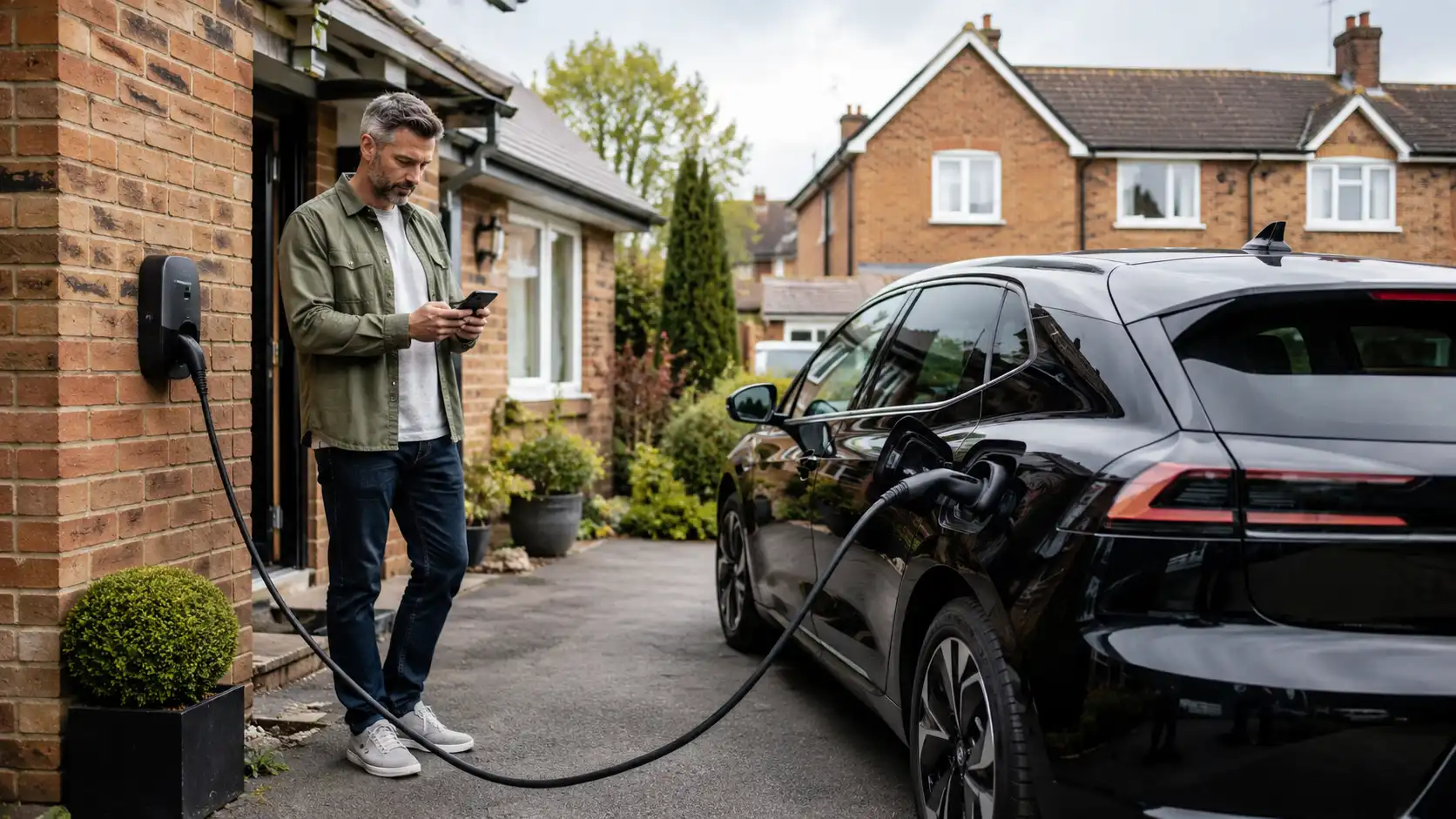
If you are thinking about buying an electric car, there is one question that normally comes before discussions about battery range, charging speed or regenerative braking: how much does it cost to charge an electric car?
The slightly annoying answer is that there isn’t one fixed price.
Charge an electric car overnight at home on a decent EV tariff and the electricity can cost only a few pounds. Plug the same car into an expensive ultra-rapid charger at a motorway service station and you could easily spend £30, £40 or more.
For UK drivers in 2026, the difference between cheap and expensive charging is now substantial enough that where and when you plug in can matter almost as much as which electric car you buy.
As of 1 July to 30 September 2026, Ofgem’s average electricity unit rate for a household on a standard variable tariff paying by Direct Debit is 26.11p per kWh.
At that rate, putting 60kWh of electricity into an electric car works out at roughly £15.67 before allowing for charging losses.
Switch to an EV-specific overnight rate of around 8p per kWh and the same 60kWh costs only £4.80.
Use a public rapid charger at around 76p per kWh and suddenly you are looking at approximately £45.60.
That is why asking how much an electric car costs to charge needs a bit more explanation.
How Much Does It Cost to Charge an Electric Car in 2026?
Here is the easiest way to look at it.
| Where You Charge | Example Electricity Price | Cost for 60kWh |
| Cheap Overnight EV Tariff | 8p/kWh | £4.80 |
| Standard Home Electricity | 26.11p/kWh | £15.67 |
| Public Standard/Fast Charger | Around 54p/kWh | £32.40 |
| Public Rapid/Ultra-Rapid Charger | Around 76p/kWh | £45.60 |
These are illustrative charging costs rather than a promise of what every driver will pay.
Your actual bill depends on your electricity tariff, battery size, charging network, location, membership discounts and how much electricity the car actually draws.
Current industry data puts slower public charging at roughly 54p per kWh, while rapid and ultra-rapid public charging can average around 76p per kWh. Individual networks can be considerably cheaper or more expensive.
So, in plain English, home charging is where an electric car generally makes the strongest financial case.
How Do You Calculate the Cost of Charging an Electric Car?
There is a very simple calculation:
Battery energy added in kWh × electricity price per kWh = charging cost
Say your electric car has a 50kWh battery and electricity costs 26.11p per kWh.
The calculation is:
50 × £0.2611 = £13.06
A theoretical 50kWh charge therefore costs about £13.06.
If you paid just 8p per kWh overnight:
50 × £0.08 = £4
And if a rapid charger cost 76p per kWh:
50 × £0.76 = £38
Same car. Same amount of electricity. Very different bill.
That is perhaps the biggest thing new EV drivers need to understand.
How Much Does It Cost to Fully Charge an Electric Car at Home?
Using the current Ofgem average electricity rate of 26.11p per kWh, the approximate figures look like this:
| Battery Size | Approximate Full Charge Cost |
| 40kWh | £10.44 |
| 50kWh | £13.06 |
| 60kWh | £15.67 |
| 75kWh | £19.58 |
| 85kWh | £22.19 |
Of course, hardly anybody repeatedly arrives home with precisely 0% battery and charges to exactly 100%.
In real life, EV charging usually consists of smaller top-ups.
You might arrive home with 35% battery, plug the car in and wake up with 80% or 90%.
That means the amount added during a normal overnight session could be considerably less than the battery’s total capacity.
There are also energy losses while charging, so the amount shown as entering the battery and the amount recorded by your electricity meter will not always be identical.
The figures above are therefore best treated as useful comparisons rather than exact bills.
How Much Does It Cost to Charge an Electric Car on an EV Tariff?
This is where things become much more interesting.
Specialist EV electricity tariffs typically give drivers a cheaper rate during selected overnight hours.
In August 2026, some major EV tariffs are offering off-peak electricity in roughly the 6.9p to 9.5p per kWh range, although tariffs, eligibility requirements and peak rates can change quickly.
Take a simple 8p/kWh example.
| Battery Size | Full Charge at 8p/kWh |
| 40kWh | £3.20 |
| 50kWh | £4.00 |
| 60kWh | £4.80 |
| 75kWh | £6.00 |
| 85kWh | £6.80 |
Now the economics look completely different.
A 60kWh battery costing less than a fiver to charge is one of the reasons drivers with a driveway and the right electricity tariff can make substantial savings compared with buying petrol or diesel.
The catch is that an EV tariff is not automatically the cheapest energy tariff for your household overall.
Some have more expensive daytime electricity.
Before switching, look at the whole household bill, not simply the attractive overnight figure printed at the top of the tariff.
How Much Does It Cost to Charge an Electric Car at a Public Charging Station?
Public charging is more complicated because Britain does not have one national price for EV electricity.
Each charging network sets its own prices.
The charger speed also matters.
Standard and fast AC charging is generally cheaper than high-powered DC rapid charging, although there are plenty of exceptions.
Recent UK charging data indicates an average of around 54p/kWh for slower public charging and roughly 76p/kWh for rapid and ultra-rapid charging.
Using those figures:
60kWh at 54p per kWh
60 × £0.54 = £32.40
60kWh at 76p per kWh
60 × £0.76 = £45.60
That is considerably more expensive than charging the same car at home.
Public rapid charging is best viewed rather like buying fuel at a motorway service station: you are partly paying for convenience, speed, expensive infrastructure and the ability to continue a long journey without waiting several hours.
What Does a Typical 20% to 80% Rapid Charge Cost?
This is a more useful question than asking about 0% to 100%.
On longer motorway journeys, many EV drivers charge between roughly 20% and 80%.
Why?
Because rapid charging normally becomes slower as the battery becomes fuller. Sitting around trying to squeeze the final few percentage points into the battery is often poor use of both time and charger capacity.
Suppose you have a 60kWh battery.
Going from 20% to 80% adds around 60% of its capacity:
60kWh × 60% = 36kWh
At 76p per kWh:
36 × £0.76 = £27.36
So a realistic motorway top-up might cost around £27, rather than the £45.60 theoretical cost of adding the full 60kWh.
For a larger 80kWh battery, adding 60% means 48kWh:
48 × £0.76 = £36.48
That is much closer to what drivers actually experience on long journeys.
How Much Does It Cost Per Mile to Charge an Electric Car?
This is arguably a better comparison than looking at the cost of a full battery.
HMRC currently uses an assumed electric-car efficiency of 3.59 miles per kWh when calculating its Advisory Electric Rate. From 1 June 2026, the rates are 7p per mile for home charging and 15p per mile for public charging. The same headline rates are due to apply from 1 September 2026.
Using 3.59 miles per kWh as a straightforward benchmark:
| Electricity Cost | Approximate Energy Cost Per Mile |
| 8p/kWh EV Tariff | 2.2p |
| 26.11p/kWh Home Tariff | 7.3p |
| 54p/kWh Public Charging | 15.0p |
| 76p/kWh Rapid Charging | 21.2p |
This table explains why statements such as “electric cars are always cheaper to fuel” need context.
An EV charged cheaply at home can be extremely inexpensive per mile.
An EV driven almost entirely on costly rapid chargers may be a very different proposition.
What Could Charging an Electric Car Cost Per Year?
Imagine a driver covering 10,000 miles annually in an EV averaging approximately 3.59 miles per kWh.
That car would require roughly 2,786kWh of battery energy to cover those miles.
The rough annual electricity cost becomes:
| Charging Pattern | Approximate Annual Electricity Cost |
| 8p/kWh Overnight | £223 |
| 26.11p/kWh Home | £727 |
| 54p/kWh Public | £1,504 |
| 76p/kWh Rapid | £2,117 |
Those numbers should not be treated as an exact ownership forecast. Weather, motorway speeds, heating, air conditioning, charging losses and vehicle efficiency all affect consumption.
But they make the main point rather nicely.
How you charge an EV can change annual running costs by well over £1,000.
Is Charging an Electric Car Cheaper Than Petrol?
It can be considerably cheaper — particularly if most charging happens at home.
The Energy Saving Trust currently estimates a full EV charge providing around 220 miles at approximately £17 at home, compared with around £37 using public fast charging and £53 using public rapid charging.
That does not mean an EV will beat every petrol car in every situation.
A highly efficient petrol hybrid driven gently may compare surprisingly well with an inefficient electric SUV relying entirely on expensive motorway rapid chargers.
Equally, somebody charging a reasonably efficient EV overnight for 7p or 8p per kWh will normally spend remarkably little on electricity per mile.
There is no meaningful comparison without knowing where the EV is charged.
Why Is Public EV Charging So Much More Expensive Than Home Charging?
This catches quite a few first-time EV buyers out.
A public chargepoint operator is not simply reselling domestic electricity.
The operator has to fund and operate:
- Charging equipment
- Grid connections
- Site rental or commercial agreements
- Installation
- Repairs
- Software
- Payment processing
- Customer support
- Network management
- Maintenance
Tax treatment matters as well.
Domestic fuel and power generally benefits from the reduced 5% VAT rate, whereas HMRC’s current position is that electricity supplied through public EV chargepoints remains standard-rated for VAT.
That means the standard 20% VAT rate currently applies to public EV charging. HMRC reaffirmed that position in May 2026 while appealing a First-tier Tribunal decision concerning the treatment.
That tax difference is another reason public electricity can cost considerably more than charging on your driveway.
Does a Faster Charger Cost More?
Often, yes but charging speed and price do not have a perfect relationship.
A 150kW or 350kW charger has the potential to put electricity into a compatible car very quickly, so rapid and ultra-rapid networks frequently charge premium rates.
But using a 350kW charger does not mean your car will automatically receive 350kW.
The vehicle determines its maximum charging rate.
Battery temperature, state of charge and the car’s charging curve also affect the actual speed.
So if your car can only accept 100kW, plugging into a 350kW unit will not suddenly make it charge at 350kW.
Check both the price and what your car can actually use.
Does Battery Size Decide How Much Charging Costs?
Battery size matters, but efficiency matters just as much.
Imagine two cars.
Car A has a 60kWh battery and manages 4 miles per kWh.
Car B also has a 60kWh battery but manages only 3 miles per kWh.
Although both theoretically cost the same to fill with electricity, Car A travels approximately 240 miles from 60kWh while Car B travels around 180 miles.
The cheaper car to run is therefore not necessarily the one with the smallest battery.
Look at miles per kWh, not just battery capacity.
It is the electric equivalent of looking at miles per gallon.
Why Does an Electric Car Use More Electricity in Winter?
British winter weather does not do EV efficiency many favours.
Cold conditions can increase energy use because batteries work differently at lower temperatures and the vehicle may need electricity to warm both the cabin and battery.
Motorway driving can have a similar effect.
An EV cruising at 70mph generally consumes more electricity per mile than the same vehicle pottering around at lower speeds.
Your real charging bill therefore depends on things such as:
- Outside temperature
- Driving speed
- Heating and air conditioning
- Vehicle weight
- Tyre pressure
- Terrain
- Driving style
That is why manufacturer’s official range figures should not be used as guaranteed real-world running-cost calculations.
Can Solar Panels Make EV Charging Cheaper?
Yes, particularly if you can charge while your solar panels are generating surplus electricity.
Instead of buying all the energy required by the car from the grid, some of it can come directly from your own generation.
The calculation becomes slightly more complicated because electricity exported to the grid may have value through an export tariff.
Using solar electricity to charge your car is therefore not necessarily “free” in the strict financial sense — you may be giving up money you could have earned by exporting it.
Even so, home solar and smart EV charging can work extremely well together.
How Much Does a Home EV Charger Cost to Install?
Electricity is only one part of the equation for somebody buying their first electric car.
There is also the charger itself.
The Energy Saving Trust estimates that a typical home chargepoint installation can cost roughly £800 to £1,200, although straightforward installations may cost less and complicated electrical work may push the price considerably higher.
Some households can currently get government support.
From 1 April 2026, eligible flats, renters and households with on-street parking can receive an EV chargepoint grant worth up to £500 per socket, with the relevant schemes scheduled to run until 31 March 2027.
Eligibility conditions apply, so it is worth checking the current government guidance before arranging installation.
What If You Do Not Have a Driveway?
This is one of the biggest dividing lines in Britain’s transition to electric cars.
If you have off-street parking, installing a home charger can unlock cheap overnight tariffs.
Someone living in a terraced house or flat without private parking may depend far more heavily on public charging.
That can substantially increase the cost per mile.
The situation is improving as more kerbside chargers and cross-pavement charging solutions become available, but anyone considering an EV without a driveway should investigate the chargers around their home before buying the car.
Do not simply look at how many chargers appear on a map.
Check:
- Their price per kWh
- Charging speed
- Parking restrictions
- Availability
- Operator
- Whether a subscription reduces the price
- Whether overnight rates are available
That ten-minute bit of homework can make a rather large difference to the annual running cost.
How Can You Pay Less to Charge an Electric Car?
There are several fairly straightforward ways to bring the cost down.
Charge at Home Whenever Possible
For most private EV drivers, home electricity remains cheaper than public rapid charging.
Save the motorway rapid charger for the journeys where you genuinely need it.
Look at EV-Specific Electricity Tariffs
Cheap overnight electricity can reduce charging costs dramatically.
Just remember to compare the daytime rate and standing charge as well.
Schedule Charging Overnight
A smart charger or the car’s own charging timer can make sure charging happens during your cheapest tariff window.
There is little point paying 30p per kWh at 7pm if exactly the same electricity costs 8p after midnight.
Compare Public Charging Prices
Public chargers located a few miles apart can have noticeably different prices.
Checking before plugging in becomes particularly worthwhile when you need 40 or 50kWh.
A 15p difference per kWh on a 50kWh session is £7.50.
Check Membership Rates
Some charging networks offer discounted electricity in return for a monthly subscription.
That might be a waste of money for somebody rapid charging twice a year, but good value for a high-mileage driver.
Stop Rapid Charging at Around 80% When Practical
Charging speed often falls as an EV battery approaches full capacity.
On a long journey, continuing to 100% may therefore take disproportionately longer.
A shorter 10%-80% or 20%-80% stop is often more practical before carrying on to the next charger.
What About Businesses Running Electric Company Cars?
The cost question matters to businesses as well as private motorists.
HMRC’s Advisory Electric Rate for fully electric company cars is currently 7p per mile for home charging and 15p per mile for public charging for the period beginning 1 June 2026.
Businesses running electric fleets should therefore think beyond the purchase price of the cars.
Charging strategy can influence operating costs considerably.
An employee regularly charging a company EV at home overnight may have a very different energy cost from a motorway-based driver relying heavily on public rapid chargers.
Businesses may also be able to obtain support through the Workplace Charging Scheme. From 1 April 2026, eligible workplace installations can receive support of up to £500 per socket, subject to the scheme rules.
For larger fleets, getting the charging infrastructure right can be as important as negotiating the vehicle lease itself.
So, How Much Should You Budget for Charging an Electric Car?
For somebody considering an EV in Britain, I would think about charging costs in four bands rather than trying to find one magic number.
Cheap home charging: roughly £3-£7 for 40-85kWh at around 8p/kWh.
Standard-rate home charging: roughly £10-£22 for 40-85kWh at the current Ofgem average of 26.11p/kWh.
Typical slower public charging: roughly £22-£46 for 40-85kWh at around 54p/kWh.
Rapid public charging: roughly £30-£65 for 40-85kWh at around 76p/kWh.
Most drivers will use a mixture.
Someone with a driveway might do 90% of their charging at home and only occasionally use a motorway rapid charger.
Another driver living in central London might rely on public kerbside charging for nearly everything.
Their cars could be identical while their annual electricity bills are completely different.
Final Verdict
So, how much does it cost to charge an electric car?
At home in Britain, a typical full charge might cost somewhere around £10 to £20 on an ordinary electricity tariff, depending largely on battery size.
Use a cheap overnight EV tariff and that figure can fall to roughly £3 to £7 for many cars.
Public charging costs considerably more. A large rapid-charge session can easily cost £25 to £45, while filling a large battery completely at an expensive public charger could cost considerably more.
For me, the useful takeaway is not that EVs are automatically cheap or expensive to run. It is that charging strategy decides the economics.
If you have access to home charging, a smart meter and a good overnight tariff, an electric car can be remarkably cheap to run per mile.
If you depend on high-priced rapid chargers every week, the saving against petrol becomes much less certain.
Before buying an EV, therefore, do not ask only how far it travels on one charge.
Ask where you are actually going to plug it in and what that electricity is going to cost.
Frequently Asked Questions
How Much Does It Cost to Charge an Electric Car at Home in the UK?
At Ofgem’s July-September 2026 average electricity rate of 26.11p/kWh, a 60kWh charge costs approximately £15.67 before charging losses. Smaller batteries cost less and larger batteries cost more.
How Much Does It Cost to Charge an Electric Car Overnight?
Some specialist EV tariffs offer off-peak electricity below 10p/kWh. At an illustrative 8p/kWh, charging 60kWh would cost £4.80.
How Much Does It Cost to Charge an Electric Car at a Public Charger?
It varies considerably. Recent UK figures put slower public charging at roughly 54p/kWh and rapid or ultra-rapid charging around 76p/kWh on average.
Is It Cheaper to Charge an Electric Car at Home?
Generally, yes. Home charging is normally substantially cheaper than using rapid or ultra-rapid public chargers, particularly if you have an off-peak EV electricity tariff.
How Much Does a 50kwh Electric Car Cost to Charge?
At 26.11p/kWh, 50kWh costs approximately £13.06. At 8p/kWh it costs £4, while electricity priced at 76p/kWh would cost £38.
Does It Cost More to Charge an Electric Car to 100%?
You pay for the electricity added, so adding more energy costs more. Rapid charging can also slow substantially towards a high state of charge, which is why drivers commonly stop around 80% during longer journeys.
How Much Does It Cost Per Mile to Run an Electric Car?
It depends heavily on the electricity price and vehicle efficiency. At 8p/kWh and 3.59 miles/kWh, electricity costs about 2.2p per mile. At 76p/kWh, the same efficiency costs around 21.2p per mile.
Can I Get a Grant Towards a Home Ev Charger?
Certain UK residents, including eligible renters, flat owners and households with on-street parking, can currently qualify for government chargepoint support. From April 2026, applicable grants increased to a maximum of £500 per socket.