Greggs has evolved from a small family bakery in Newcastle into one of Britain’s biggest food-to-go businesses.
With thousands of outlets, millions of regular customers and annual sales exceeding £2 billion, its success has naturally raised questions about who owns Greggs today and whether the founding family still controls the company.
Unlike privately owned restaurant chains, Greggs operates as a publicly listed company with ownership distributed among institutional and individual shareholders.
Our analysis of its annual financial statements, shareholder disclosures and latest business developments shows how this ownership structure supports national expansion, franchising and long-term investment.
The story also reveals how a family-founded bakery became a major British retail business without being acquired by a supermarket, multinational food corporation or private equity group.
Who Owns Greggs in 2026?
Greggs is owned by the shareholders of Greggs plc, a British public limited company listed on the London Stock Exchange under the ticker symbol GRG.
There is no single individual, family or parent corporation that owns the entire business. Instead, ownership is distributed among institutional investors, asset managers, investment funds and individual shareholders.
The business originally belonged to the Gregg family, but its ownership structure changed significantly after the company joined the London Stock Exchange in 1984.
Today, Greggs remains an independently listed British business headquartered in Newcastle upon Tyne.
According to the official Companies House register, Greggs plc (company number 00502851) is an active public limited company, incorporated on 29 December 1951. Its registered office is at Greggs House, Quorum Business Park, Newcastle upon Tyne, NE12 8BU.
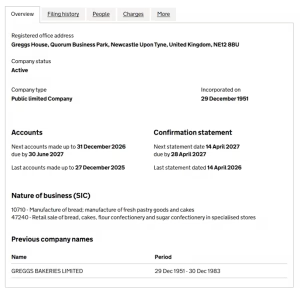
Official Companies House record confirming Greggs plc’s active status, company registration details, incorporation date and registered office address.
Interestingly, the Companies House records also show that the business was previously registered as Greggs Bakeries Limited until 30 December 1983, shortly before its stock market flotation in 1984.
The company’s registered activities include the manufacture of bread, fresh pastry goods and cakes (SIC 10710), alongside the retail sale of bakery and confectionery products (SIC 47240).
Our review of these corporate records confirms Greggs’ legal identity and its transition from a family-founded bakery business to a public limited company. However, the Companies House overview does not identify every current shareholder or establish their individual ownership percentages.
Greggs Ownership at a Glance
| Business detail | Information |
| Company name | Greggs plc |
| Ownership | Publicly owned by shareholders |
| Founder | John Gregg |
| Established | 1939, with the first shop opening in 1951 |
| Stock exchange listing | London Stock Exchange |
| Share ticker | GRG |
| Chief executive | Roisin Currie CBE |
| Chair | Matt Davies |
| Headquarters | Newcastle upon Tyne, England |
| Company registration | 00502851 |
| Latest reported shop count | 2,796 at 26 September 2026 |
| Parent company | No separate parent company controlling Greggs plc |
The distinction between owning and managing the company is important.
Shareholders collectively own Greggs, while the board and executive management are responsible for overseeing and operating the business.
Who Are the Biggest Shareholders in Greggs?
Greggs attracts investment from financial institutions because of its established brand, national retail presence and position within the UK consumer market.
Large investment firms may hold shares directly, manage investments on behalf of clients or exercise voting rights through funds and other arrangements.
According to the company’s 2025 annual report, two substantial voting-rights holdings were disclosed as at 3 March 2026.
| Notified shareholder | Shares reported | Shareholding |
| J.P. Morgan Securities plc | 5,268,899 | 5.15% |
| Silchester International Investors LLP | 5,112,962 | 5.00% |
These were the holdings formally identified in that report, rather than a complete or continuously updated list of all investors. Shareholdings and voting-rights positions can change through subsequent transactions.
Neither disclosed position represented a controlling majority.
Why Do Investment Companies Own Greggs Shares?
Institutional investors look for companies capable of generating sustainable earnings, maintaining competitive advantages and producing returns over time.
Greggs has several characteristics that can attract long-term investors:
- Brand recognition: A nationally established food-to-go brand with substantial customer awareness.
- Recurring demand: Breakfast, lunch, coffee and snack purchases create regular opportunities for repeat transactions.
- Retail expansion: New shops allow the company to enter additional locations.
- Integrated operations: Manufacturing and distribution are managed within the wider business.
- Dividend potential: Ordinary shareholders may receive cash distributions when declared.
Nevertheless, an established brand does not eliminate investment risk.
Changes in food costs, labour expenses, consumer spending and retail competition can affect profitability.
Does Any Shareholder Control Greggs?
The company’s publicly disclosed ownership does not identify a shareholder holding a majority controlling stake.
However, ownership percentages should not be confused with practical influence.
A shareholder holding 5% of a company can still have an important voice in matters such as executive remuneration, governance and long-term strategy.
Institutional investors frequently engage with company boards, particularly when performance or capital allocation is under pressure.
Our assessment is that Greggs’ dispersed ownership creates a conventional listed-company governance model rather than an owner-managed family business.
Who Founded Greggs?
Greggs was founded by John Gregg, who began his business in Newcastle in 1939.
His original operation was much smaller than the nationwide bakery chain consumers recognise today.
John Gregg initially delivered fresh eggs and yeast to customers using a bicycle.
This early business developed into a more established bakery operation, culminating in the opening of the first Greggs shop in Gosforth, Newcastle, in 1951.
The business grew through local demand, affordable products and an expanding bakery network.
Its history demonstrates how a relatively simple food business can develop into a national retail brand through consistent operations and long-term investment.
How Did Ian Gregg Expand the Business?
John Gregg’s son, Ian Gregg, played an important role in the company’s subsequent development.
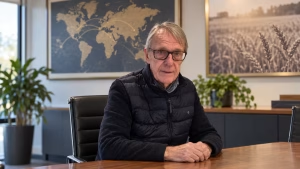
Ian Gregg played a key role in transforming Greggs from a regional family bakery into a nationwide business, helping drive its expansion and eventual stock market flotation in 1984.
The business expanded beyond its original local market and progressively established a wider presence across Britain.
During this period, the company evolved from a family bakery into a much larger organisation requiring investment in premises, production facilities, management and distribution.
The family’s expansion strategy helped create the foundations for the modern company.
Greggs’ stock market flotation in 1984 marked a particularly important stage in that transformation.
Is Greggs Still Owned by the Gregg Family?
No. The Gregg family no longer controls Greggs.
Although the company retains its original family name, it is now a publicly traded business.
Its 1984 flotation enabled shares to be held by investors beyond the founding family.
Over time, the shareholder base broadened considerably.
This does not necessarily mean that no Gregg family member holds any shares. A small private holding would not ordinarily appear in a list of substantial shareholders.
The important distinction is that family ownership is no longer the controlling structure of the business.
What Happened When Greggs Went Public?
Greggs was admitted to the London Stock Exchange in April 1984.
At the time, its stock market valuation was approximately £15 million, and it operated just over 260 shops.
Becoming publicly listed provided a different framework for business ownership and investment.
Rather than relying exclusively on family capital or private funding, the company could operate within public equity markets.
That change also brought greater financial reporting, shareholder accountability and corporate governance obligations.
For entrepreneurs, the development illustrates how a founder-led business can evolve through several ownership stages without losing its original trading identity.
Who Is the CEO of Greggs?
Roisin Currie CBE is the chief executive of Greggs.
She is responsible for leading the company’s executive strategy and day-to-day business operations, supported by the senior leadership team.
Matt Davies serves as chair of the board, while Richard Hutton is the chief financial officer.
| Leadership position | Individual | Main responsibility |
| Chief Executive | Roisin Currie | Business strategy and executive leadership |
| Chair | Matt Davies | Board leadership and governance |
| Chief Financial Officer | Richard Hutton | Financial management and capital planning |
Being the chief executive does not mean Roisin Currie personally owns Greggs.
She manages the company on behalf of its shareholders.
The board, meanwhile, is responsible for overseeing executive decisions, governance, risk and long-term corporate performance.
In the company’s July 2026 interim announcement, Currie explained its continued priorities:
“We remain focused on opening shops in more catchments and introducing convenient ways for customers to pick up Greggs favourites.”
Her comments reflect a strategy based on increasing access to Greggs products rather than relying solely on established high-street branches.
How Does Greggs Make Money?
Greggs generates revenue primarily by selling food and drinks through its company-managed shops, alongside commercial arrangements involving franchise operators and retail partners.
Although sausage rolls and baked products are closely associated with the brand, its revenue model is broader.
1. Company-Managed Shops
Most Greggs locations are managed directly by the company.
These businesses generate sales from food and drinks purchased by customers, including through eligible delivery channels.
Greggs manages the operation of these shops and bears the associated staffing, property and operating costs.
2. Franchised Shops
Some Greggs outlets operate through franchise partners.
These arrangements are particularly useful in locations where established operators already have access to suitable premises and customer traffic.
Examples include motorway services, petrol forecourts and transport facilities.
The franchising model enables Greggs to broaden its distribution network while working with experienced commercial partners.
3. Grocery and Retail Partnerships
Greggs also distributes selected products through supermarket partnerships.
Frozen and bake-at-home products enable customers to purchase Greggs-branded food outside a traditional shop.
These arrangements create an additional business-to-business revenue channel.
4. Coffee and Other Drinks
Coffee has become an increasingly important part of Greggs’ commercial proposition.
Rather than functioning exclusively as a bakery, the business competes for breakfast, lunch and beverage purchases.
This has helped Greggs expand its position in the branded coffee market.
In fact, Greggs has overtaken Costa in one major measure of UK branded coffee-shop outlet numbers. The wider implications of Greggs overtaking Costa in the UK demonstrate how the business now competes across several food and drink categories.
How Many Greggs Shops Are Company-Owned or Franchised?
Greggs reported 2,796 shops trading as at 26 September 2026.
Of these, 2,157 were company-managed and 639 operated as franchised units.
| Shop ownership and operation | Number | Share of network |
| Company-managed shops | 2,157 | 77.1% |
| Franchised units | 639 | 22.9% |
| Total | 2,796 | 100% |
These percentages refer to the distribution of the shop network, not to the percentage ownership of Greggs plc shares.
That difference matters.
A franchise operator can own or operate an individual branded outlet without owning the Greggs brand or controlling the listed parent company.
Our analysis suggests that the mixed operating model offers Greggs an advantage: it can maintain substantial direct operational oversight while using partnerships to reach specialist sites.
Readers examining the scale of the network can also explore how many Greggs shops operate across the UK, including changes in store numbers and location formats.
How Much Money Does Greggs Make?
Our review of its published financial statements shows a business generating substantial revenue, although increasing sales have not always translated into equally strong profit growth.
Greggs Financial Performance in 2025
| Financial indicator | 2025 | Annual change |
| Total sales | £2.151 billion | +6.8% |
| Underlying operating profit | £187.5 million | -4.0% |
| Underlying profit before tax | £171.9 million | -9.4% |
| Statutory profit before tax | £167.4 million | -17.9% |
| Underlying diluted earnings per share | 122.8p | -10.7% |
| Ordinary dividend per share | 69.0p | Unchanged |
The numbers highlight a key consideration for shareholders.
Revenue growth does not automatically produce higher earnings.
Greggs increased its total sales in 2025, but profitability was affected by cost pressures, investment and more challenging market conditions.
Its underlying pre-tax profit margin fell to approximately 8%, compared with about 9.4% in 2024.
That makes cost management and returns on investment central questions for shareholders.
How Has Greggs Performed in 2026?
The first half of 2026 showed an improvement in several important financial measures.
Greggs reported:
- Total sales: £1.1015 billion, up 7.2%.
- Operating profit: £86.5 million, up 22.9%.
- Pre-tax profit: £76 million, up 19.7%.
- Interim dividend: 19p per share.
- Like-for-like sales: Up 2.1% in company-managed shops.
The trading picture improved further in the third quarter.
For the 13 weeks ending 26 September 2026, total sales increased by 7.7%, while company-managed like-for-like sales rose 3.4%.
Across the first 39 weeks of the financial year, total sales were 7.4% higher.
These figures suggest that customer demand, new product development and expansion continued supporting revenue growth.
However, investors still need to consider future operating costs, capital expenditure and the sustainability of profit margins.
Why Has Greggs Become So Successful?
Greggs’ expansion has not depended on one product or a single marketing campaign.
Our review identifies five structural factors behind its commercial position.
Affordable Food Positioning
Greggs targets customers seeking convenient food at accessible prices.
This can support demand among commuters, workers, families and customers trying to manage everyday spending.
During periods of economic uncertainty, an established value proposition can offer an advantage over higher-priced competitors.
High-Frequency Customer Demand
Bakery and food-to-go purchases are often repeated throughout the working week.
Breakfast, coffee, lunch and snacks provide several opportunities to serve the same customer.
This makes transaction frequency particularly important.
National Brand Recognition
Greggs has developed strong recognition across the UK.
Its distinctive products and established identity reduce the challenge of introducing the brand into new locations.
Manufacturing and Distribution Control
Greggs maintains a vertically integrated operating structure, including its own manufacturing and logistics operations.
This provides greater control over important elements of production, product availability and distribution.
Vertical integration also creates financial responsibilities because facilities, equipment and logistics infrastructure require substantial capital investment.
Continuous Retail Expansion
Greggs has increasingly moved beyond traditional high streets.
New locations include transport hubs, retail parks, service stations and supermarkets.
The company also continues testing smaller and self-service formats.
From a business perspective, these developments demonstrate how an established brand can find growth opportunities by changing where and how products reach customers.
What Are Greggs’ Biggest Business Risks?
Although Greggs has an established market position, its ownership structure does not protect investors from financial and operational challenges.
Rising Operating Costs
Food production, employment, property and distribution costs can place pressure on margins.
Even when sales increase, profitability can weaken if expenses rise more quickly.
Consumer Spending Pressure
Greggs operates in a competitive market where purchasing decisions can be influenced by household budgets.
Value positioning may help retain customers, but reduced spending can still affect transaction volumes and product choices.
Expansion Costs
Opening new locations requires investment in shops, equipment, logistics and operational capacity.
New sites must generate sufficient returns to justify that spending.
Manufacturing Restructuring
In September 2026, Greggs announced proposals to consolidate parts of its manufacturing operations.
The proposals could result in the closure of four sites and approximately 740 redundancies over a two-and-a-half-year period, subject to consultation.
Greggs estimated associated cash costs of around £60 million, including approximately £40 million of capital expenditure.
The business expects the changes to generate annual pre-tax operating savings of around £20 million once the programme is completed, with savings anticipated across 2028 and 2029.
These are proposed changes and forecasts rather than completed savings.
For shareholders, the central question is whether the longer-term financial benefits outweigh the implementation costs, disruption and workforce impact.
How Does Greggs Reward Its Shareholders?
Greggs can return value to shareholders through dividends and changes in the market value of its shares.
Dividend Payments
A dividend is a distribution declared by a company to eligible shareholders.
Greggs’ total ordinary dividend for 2025 was 69p per share, unchanged from the previous year.
For example, a shareholder with 100 shares would receive £69 in gross ordinary dividends for that year, assuming they held the shares on the relevant qualifying dates.
Dividend income may be subject to tax depending on the investor’s circumstances.
Dividends are not guaranteed and can be increased, reduced or suspended.
Share Price Appreciation
Investors may also benefit if the market price of Greggs shares rises.
However, a higher future share price cannot be assumed.
Share prices respond to numerous factors, including trading results, economic conditions, investor expectations and wider stock market movements.
Employee Profit-Sharing
Greggs also has an employee profit-sharing programme.
In 2025, it reported approximately £20.2 million in colleague profit-sharing.
This is different from ordinary shareholder dividends and illustrates how the business distributes part of its financial success to employees.
Can Anyone Buy Shares in Greggs?
Yes. Because Greggs plc is publicly listed, eligible investors can buy shares through a brokerage or investment platform offering London Stock Exchange securities.
The company’s trading symbol is GRG.
A prospective investor would generally need to select a suitable investment account, research the company’s performance, review the current share price and understand the costs and risks before placing an order.
Buying shares makes someone a part-owner of Greggs plc, but a small shareholder does not gain personal control over company operations.
Investors should also distinguish between the price quoted in pence and pounds when reviewing UK-listed shares.
For example, a hypothetical quote of 2,000p means £20 per share. That is an illustration, not a current Greggs share-price quotation.
Can Someone Open Their Own Greggs Franchise?
Greggs does operate franchised locations, but its franchise model should not be confused with an unrestricted opportunity for anyone to open a bakery under its name.
The company works with established commercial partners, particularly businesses operating roadside, travel and other suitable retail locations.
One example is Motor Fuel Group, which has partnered with Greggs on forecourt operations and its Greggs Express self-service trial.
Franchise relationships can involve requirements relating to premises, operations, supply chains, quality standards and commercial experience.
There is no basis for assuming that an individual can simply pay a standard franchise fee and receive permission to open a Greggs shop.
Prospective commercial partners should contact Greggs directly about its current partnership arrangements rather than relying on speculative online franchise-cost estimates.
What Is Our Business Assessment of Greggs?
Based on our analysis of published financial performance, operating structure, brand positioning and ownership disclosures, we assessed Greggs across four business criteria.
These are editorial assessment ratings, not independently surveyed customer percentages or investment-return forecasts.
| Assessment category | Our rating | Reason |
| Ownership transparency | 90% | Public financial statements, governance disclosures and regulatory reporting |
| Brand and market position | 85% | Established recognition, national network and competitive food-to-go positioning |
| Expansion potential | 80% | Continued shop growth and new retail formats, balanced against investment requirements |
| Profit resilience | 70% | Strong revenue generation but recent pressure on earnings and margins |
| Overall editorial assessment | 81% | Rounded average of the four category ratings |
Our assessment indicates that Greggs has a comparatively strong commercial foundation, particularly in brand recognition, physical distribution and business scale.
However, revenue growth alone is not enough to determine whether the company’s shares represent good value.
The ability to preserve margins, manage capital expenditure and generate sustainable returns will remain important for future financial performance.
What Can UK Entrepreneurs Learn From Greggs’ Ownership Story?
The journey from a family bakery to a publicly listed company offers several lessons for business owners.
First, brand identity can survive a change in ownership. Greggs retains the founder’s surname despite no longer operating as a family-controlled company.
Second, growth requires supporting infrastructure. A successful retail concept must develop manufacturing, distribution, technology and management systems as the network expands.
Third, partnerships can complement direct ownership. Greggs operates most shops itself while using franchise partners in commercially attractive locations.
Fourth, revenue and profitability must be analysed separately. Its 2025 figures show that rising sales can coincide with declining profits.
Finally, the business demonstrates how an established consumer brand can continue adapting its format rather than relying exclusively on its original products or sales channels.
For entrepreneurs considering long-term expansion, these lessons are as important as the company’s headline shop count.
Final Thoughts
So, who owns Greggs in 2026?
The company belongs collectively to the shareholders of Greggs plc, not to one individual, the founding Gregg family or another food retail corporation.
John Gregg established the original business, and subsequent generations helped develop it into a nationally recognised bakery chain. Its stock market flotation in 1984 eventually created the broader shareholder-owned structure that exists today.
Our financial analysis also shows that ownership is only one part of the story. Greggs combines a predominantly company-managed retail network with franchise partnerships, an integrated supply chain and an expanding range of food-to-go products.
With more than 2,700 shops, substantial annual revenue and continued investment in national expansion, Greggs remains an important example of how a British family-founded business can develop into a large publicly owned enterprise while retaining its original brand identity.
Frequently Asked Questions
Is Greggs a British Company?
Yes. Greggs plc is a British company headquartered in Newcastle upon Tyne, England, and listed on the London Stock Exchange.
Does Tesco Own Greggs?
No. Tesco does not own Greggs. The companies have retail partnerships, including Greggs locations and products associated with Tesco stores.
Is Greggs Owned by McDonald’s?
No. Greggs and McDonald’s are separate businesses with different corporate ownership structures.
Is Greggs Owned by Private Equity?
Greggs is publicly listed rather than being owned by a single private equity parent company. Investment funds may nevertheless hold shares.
Does the Greggs Foundation Own Greggs?
No. The Greggs Foundation is a charitable organisation connected with the business. Greggs’ 2025 annual report recorded that the foundation held 281,000 shares, representing only a small minority interest.
Who Receives the Profits Made by Greggs?
Profits belong to the company and may be retained for investment, used to support business operations or distributed through declared dividends. Greggs also operates an employee profit-sharing scheme.
Is Greggs Planning to Open More Shops?
Yes. In its September 2026 trading update, Greggs continued to expect around 100 to 110 net new shop openings during 2026, with longer-term infrastructure investment designed to support a substantially larger estate.