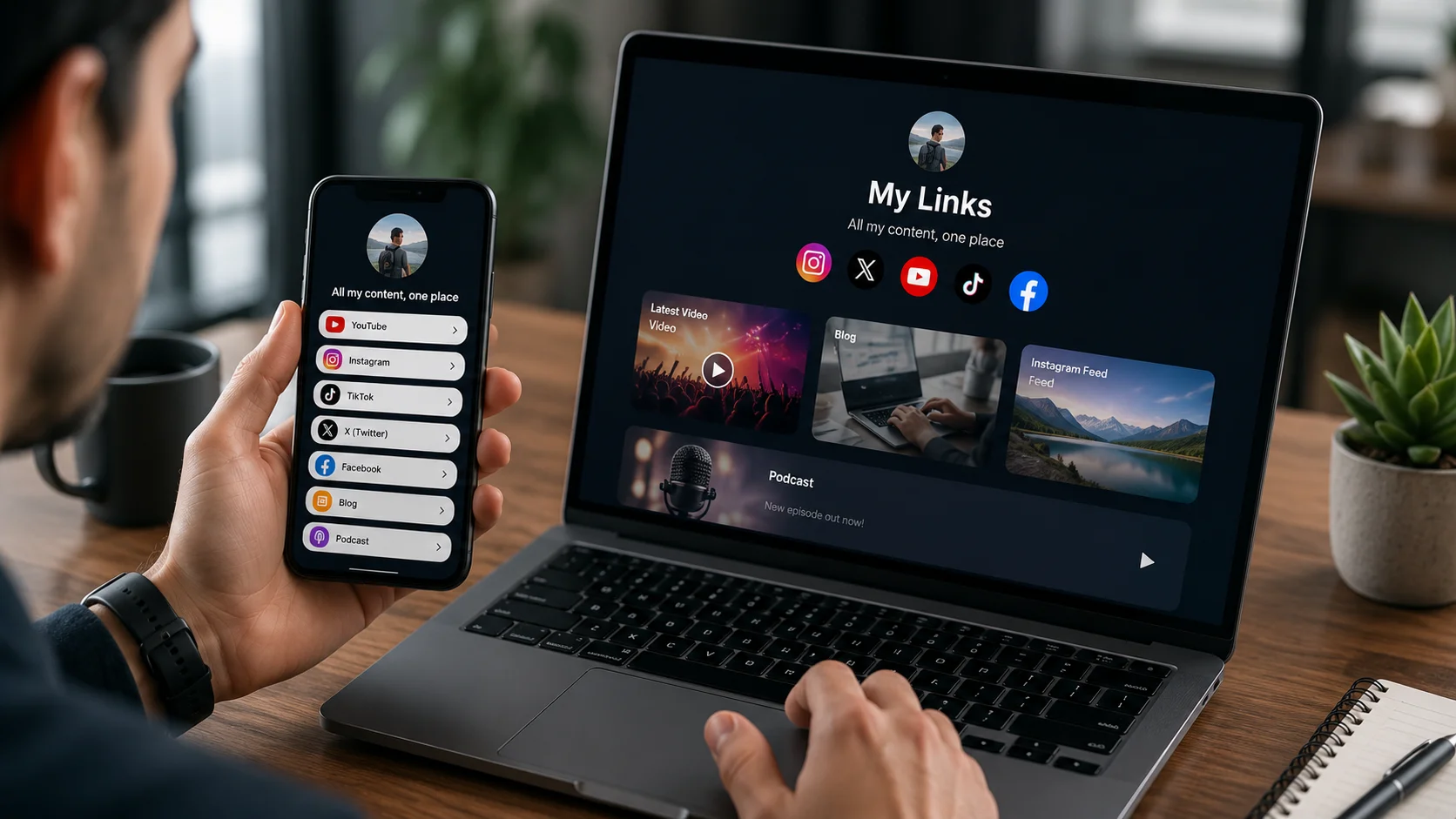
The phrase social media stuff EmbedTree has been appearing increasingly in searches connected with social-media links, embedded posts, content hubs and online profile management. At first glance, it sounds like the name of a conventional social-media management platform. The reality is slightly more complicated.
EmbedTree’s current website describes itself primarily as a destination covering games, software, social media, technology tips and digital tools. At the same time, content published on EmbedTree itself describes an EmbedTree-style service as a way of grouping social links, media and embeds on a single page.
For users trying to understand social media stuff EmbedTree, the most useful interpretation is therefore a system for organising social-media content, links and embedded media so that audiences can access them more easily from one central location.
What Is Social Media Stuff EmbedTree?
Social media stuff EmbedTree generally refers to collecting social-media profiles, posts, videos and other digital content into an organised online hub.
Instead of asking users to search separately for a brand on Instagram, TikTok, YouTube and other networks, an EmbedTree-style structure can provide a central point from which visitors discover that content.
The concept combines two familiar ideas:
- Social-media embedding, where content from another platform appears directly on a webpage.
- Link organisation, where several important destinations are collected together on one page.
This distinction is important because not every page discussing EmbedTree uses the term in exactly the same way.
The main EmbedTree website currently positions the brand around technology, gaming, software and social-media information, while one of its own 2026 guides describes EmbedTree as a page builder capable of grouping social links, embeds and media.
As a result, readers should be cautious about assuming that every feature attributed to “EmbedTree” elsewhere online is part of a clearly documented software product.
Social Media Stuff EmbedTree at a Glance
| Area | What It Means |
| Main purpose | Organising social-media links and digital content |
| Typical content | Social profiles, videos, posts, website links and media |
| Main benefit | Gives audiences a central place to discover content |
| Useful for | Creators, businesses, marketers and publishers |
| Website integration | Can involve links, embeds or third-party widgets |
| SEO benefit | Can improve content usefulness, but does not automatically improve rankings |
| Main concern | Too many third-party embeds can affect page performance |
The key idea is organisation rather than simply adding as many social links as possible.
How Does Social Media Stuff EmbedTree Work?
A social-media hub typically sits between a user’s social accounts and their website audience.
For example, a business could have active profiles on Instagram, TikTok and YouTube. Rather than displaying three plain URLs, it could create a central social section showing selected content from those channels.
There are several ways this can work.
1. Social Profile Links
The simplest structure contains buttons or links leading to each social-media profile.
A creator might include links to:
- TikTok
- YouTube
- X
- A newsletter
- An online shop
- A portfolio
- A main website
This approach is lightweight because the page is mainly providing navigation rather than loading external media.
2. Individual Social Media Embeds
A website can also display specific posts or videos directly on the page.
This isn’t unique to EmbedTree. Major social networks provide official mechanisms for embedding content.
Meta provides an oEmbed system for displaying eligible public Instagram content on external websites. TikTok similarly offers video embedding tools, while YouTube provides its established iframe-based embedded player.
That means businesses do not necessarily need an all-in-one third-party platform simply to display individual social posts.
3. A Multi-Platform Content Hub
The more advanced interpretation of social media stuff EmbedTree is a page bringing several types of social content together.
For example, a central creator page could contain:
- A latest YouTube video.
- A featured TikTok.
- Selected Instagram content.
- A link to a newsletter.
- A link to a product or service.
- A booking or contact button.
The objective is to reduce the distance between someone discovering the creator and completing the desired action.
Why Are Creators and Businesses Interested in EmbedTree-Style Pages?
Social-media audiences are increasingly distributed across different platforms.
A potential customer may discover a company through TikTok but prefer watching longer videos on YouTube. Another visitor may want to visit the company’s website, while someone else simply wants contact information.
A central content hub provides a clearer route between those channels.
Creating a More Organised Digital Presence
The biggest advantage is simplicity.
Instead of placing numerous unrelated URLs in different locations, important destinations can be grouped according to their value.
For a small business, this might mean prioritising:
- The main website.
- A product or service page.
- Recent social content.
- Contact information.
- Other social profiles.
For a creator, the order might instead prioritise the newest video, newsletter or commercial partnership.
Making Social Content Easier to Discover
Social platforms frequently operate as separate ecosystems. Someone following a business on one network may have no idea that it publishes useful material somewhere else.
A central hub can expose those additional channels without expecting visitors to search manually.
Reusing Existing Content
Businesses spend considerable resources creating videos, photography and social posts.
Embedding selected material on a website allows some of that content to serve a second purpose rather than disappearing rapidly down a social-media feed.
TikTok specifically provides tools for displaying videos and creator profiles on websites, while YouTube supports embedded video playback through its player technology.
What Is the Difference Between Linking and Embedding?
This is one of the most important distinctions surrounding social media stuff EmbedTree.
A link directs the visitor somewhere else.
An embed displays external content within the current webpage.
Imagine a company has produced a useful YouTube tutorial.
With a link, the visitor clicks and moves to YouTube.
With an embed, the visitor can potentially watch the video without leaving the company’s webpage.
The same principle applies to certain posts from Instagram, Facebook, TikTok and other supported platforms.
Neither approach is automatically better.
Links are generally simpler and lighter, while embeds can create a richer experience.
A good social-media hub often combines both.
Can Social Media Stuff EmbedTree Help With SEO?
Social-media embedding and SEO are frequently discussed together, but businesses should avoid exaggerated claims.
Simply embedding a social-media post does not automatically move a page higher in Google’s results.
The more realistic SEO benefit comes from improving the usefulness and media richness of the page.
For video specifically, Google states that videos hosted through third-party platforms such as YouTube, Vimeo or Facebook may be indexed both on the publisher’s webpage and on the original platform when Google’s eligibility requirements are met.
That is different from saying an embed itself is a direct ranking boost.
For SEO, the surrounding first-party content remains important. A page should still contain useful original information explaining what visitors are looking at and why the embedded content matters.
A Better SEO Approach
Businesses using social-media embeds should consider them supporting content rather than the entire page.
For example, instead of publishing a page consisting only of three Instagram posts, a business could include:
- An original introduction.
- Helpful written information.
- Relevant headings.
- Selected social content.
- A clear next action.
- Appropriate internal links.
- Original images where useful.
The embedded media then complements the page rather than replacing meaningful content.
Could Too Many Social Media Embeds Slow Down a Website?
Yes. This is one of the most important disadvantages to consider.
Social-media widgets and video players commonly rely on resources loaded from third-party servers. Google’s web performance guidance warns that third-party embeds can negatively affect performance and recommends techniques such as lazy loading and prioritising first-party content.
For that reason, placing ten embedded social feeds on a single landing page simply because they are available would rarely be sensible.
A better strategy is to display only content that helps the visitor.
Ways to Keep an EmbedTree-Style Page Fast
Businesses should:
- Keep the number of embeds limited.
- Position important first-party content before heavy widgets.
- Lazy-load appropriate below-the-fold embeds.
- Compress first-party images.
- Remove outdated social widgets.
- Test pages on mobile connections.
- Regularly check Core Web Vitals and page performance.
Google’s web performance guidance notes that social-media and video embeds can require substantial additional resources, making performance testing particularly important.
What Social Media Content Should Businesses Include?
Not everything deserves space on a central social-media page.
Businesses should prioritise content according to what they want visitors to do next.
For an E-Commerce Business
A useful structure could be:
- Featured product.
- Recent product demonstration.
- Customer-generated social content.
- Instagram profile.
- TikTok profile.
- Shop link.
The commercial action should remain obvious instead of being buried underneath social links.
For a Content Creator
A creator might prioritise:
- Latest video.
- Most important social profile.
- Newsletter subscription.
- Sponsorship information.
- Portfolio.
- Other social networks.
For a Local Business
A local company may obtain more value from:
- Main service page.
- Contact page.
- Customer examples.
- Social proof.
- Instagram or Facebook.
- Booking information.
The best EmbedTree-style page is therefore not necessarily the one containing the most links. It is the one that guides visitors towards the most valuable destinations.
How to Build an Effective Social Media Content Hub?
There is no need to make the structure complicated.
Step 1: Decide the Primary Goal
Start by identifying what visitors should ideally do.
That might be:
- Buy something.
- Read an article.
- Subscribe.
- Contact the business.
- Watch a video.
- Follow an account.
- Book a consultation.
One primary action makes it easier to decide what should appear first.
Step 2: Audit Existing Social Channels
List every active channel and assess whether each still deserves promotion.
An abandoned social profile with posts from several years ago can create a weaker impression than simply removing the link.
Step 3: Prioritise Important Content
Put commercially or strategically valuable links near the top.
Users should not have to search through 15 buttons to reach the business’s main website.
Step 4: Add Selected Embedded Content
Use embeds when seeing the actual content is more useful than following a simple link.
Official embedding options should be preferred where practical because they provide a clearly documented connection between the website and the source platform. Instagram, TikTok and YouTube all maintain official embedding technologies.
Step 5: Test the Mobile Experience
Social-media traffic is frequently consumed on phones, making a clean mobile presentation particularly important.
Buttons should be easy to tap, videos should fit the screen and users should not have to move around large desktop-oriented widgets.
Step 6: Monitor the Page
Social platforms change their interfaces, APIs and embedding systems over time.
Businesses should therefore periodically check:
- Whether embeds still load.
- Whether linked profiles are active.
- Whether important links work.
- Whether the page remains fast.
- Whether the most valuable links receive attention.
Social Media Stuff EmbedTree vs a Basic Link Page
The biggest distinction is the type of experience being created.
| Basic Link Page | EmbedTree-Style Content Hub |
| Mainly external links | Links plus embedded media |
| Lightweight | Potentially more resource-intensive |
| Simple navigation | Richer browsing experience |
| Easy to maintain | Requires more checking |
| Best for directing traffic | Best for showcasing content |
A creator who only needs five destinations may be better served by a simple link page.
A media company, influencer or brand that wants visitors to preview content before clicking elsewhere may gain more from an embedded content hub.
Is Social Media Stuff EmbedTree Safe to Use?
The concept itself is not inherently unsafe, but businesses should be careful when adding third-party scripts or connecting social accounts to unfamiliar services.
Before giving a third-party application access to an account, users should check:
- Who operates the service.
- What permissions it requests.
- Whether those permissions are necessary.
- How account access can be revoked.
- What information is collected.
- Whether the service has clear privacy terms.
- Whether official platform embedding is sufficient instead.
This is particularly relevant to EmbedTree because online descriptions of its precise functionality are currently inconsistent.
Its main website describes EmbedTree broadly as a technology, software, gaming and social-media information destination, while another page on the same domain describes it as a social-page builder.
Users should therefore verify the specific feature they intend to use rather than relying solely on claims made by third-party articles.
Is Social Media Stuff EmbedTree Worth Using?
The social media stuff EmbedTree concept can be valuable when it solves a genuine organisation problem.
Creators and businesses with audiences spread across several platforms may benefit from having one central destination that organises their most useful content.
However, the objective should not simply be to embed everything.
An effective social hub should be:
- Easy to understand.
- Fast to load.
- Mobile friendly.
- Selective about content.
- Focused on a clear user action.
- Regularly maintained.
Businesses that only need to direct visitors towards a few profiles may find simple links sufficient. Those with strong video, creator or user-generated content may gain more from strategically embedding selected media.
Final Thoughts
Social media stuff EmbedTree is best understood as an approach to bringing scattered social links, posts and media into a more organised digital experience. The term is used inconsistently online, and readers should be careful about treating every claimed EmbedTree feature as verified.
What matters most for businesses is the underlying strategy: make important content easier to discover, give visitors a clear route to the next action and avoid damaging website performance with unnecessary third-party widgets.
Used selectively, social-media links and embeds can turn a fragmented digital presence into a much clearer journey for customers, followers and potential clients.
FAQs About Social Media Stuff EmbedTree
What does social media stuff EmbedTree mean?
It generally describes organising social-media links, posts, videos and embedded content into one central online location.
Is EmbedTree a social media platform?
EmbedTree’s current website describes itself primarily around technology, gaming, software and social-media content, although content on the same domain also describes an EmbedTree-style social page-building service.
Can Instagram posts be embedded on a website?
Yes. Meta provides official methods for embedding eligible public Instagram posts on external websites.
Can TikTok videos be added to a website?
Yes. TikTok provides official video embedding functionality and an oEmbed API for supported content.
Can YouTube videos be included in an EmbedTree-style page?
Yes. YouTube provides an iframe-based embedded player that allows videos to be played directly within websites and applications.
Do social-media embeds improve Google rankings?
Not automatically. Google can index eligible third-party embedded videos, but businesses should use embeds because they improve the page for visitors rather than assuming they are a direct ranking shortcut.
Can social-media embeds make a website slower?
They can. Third-party embeds may load additional JavaScript and other resources, so limiting embeds and using performance techniques such as lazy loading can help.